Malaysia-Vietnam Cargo Insurance for Electronics
Malaysia-Vietnam electronics cargo insurance for EMS firms moving components and WIP between Penang, Kulim, and Vietnamese assembly plants.
Malaysia-Vietnam Cargo Insurance for Electronics
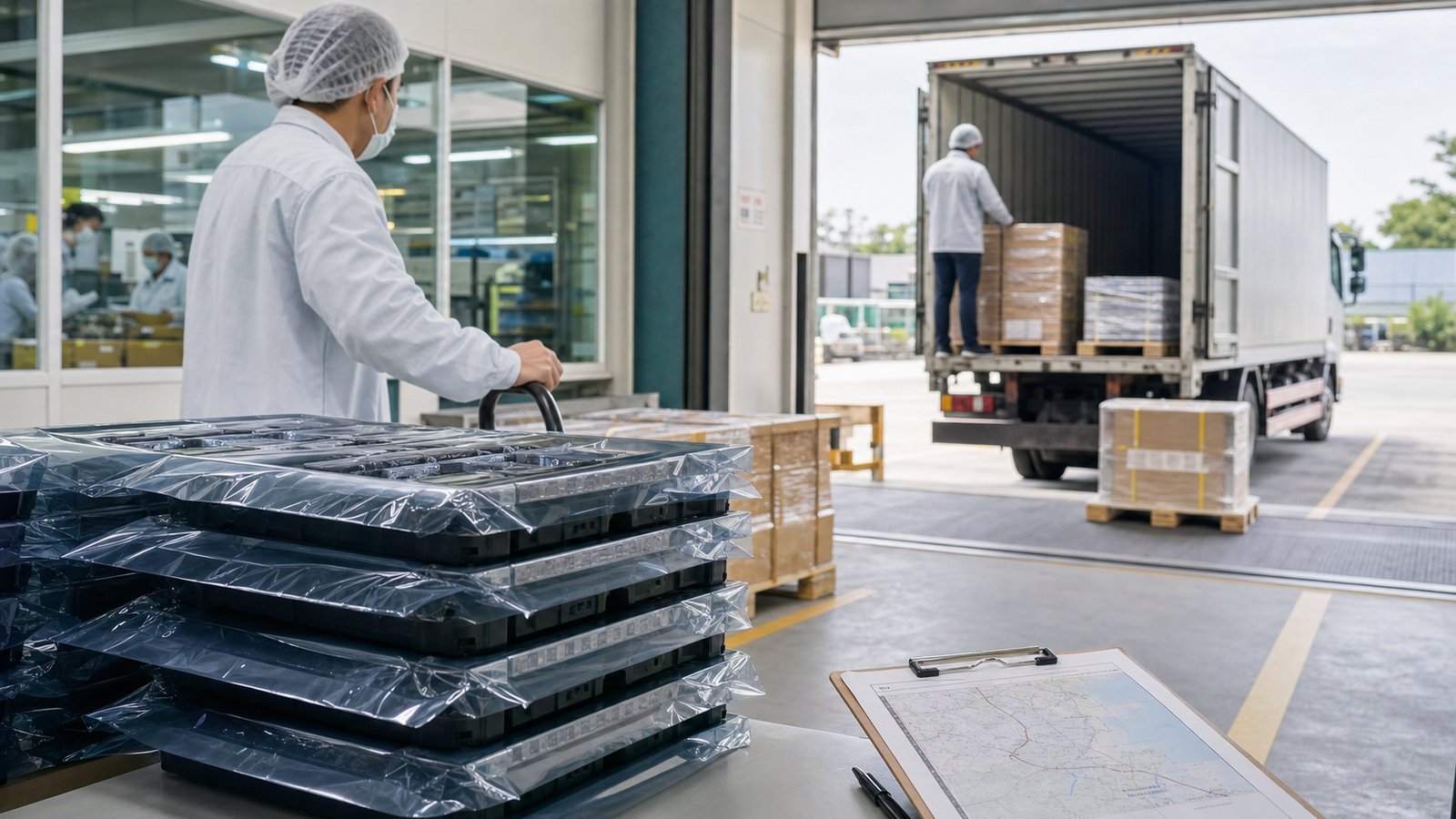
Illustrative example: not a specific client case. A Penang EMS firm ships IC trays and PCB assemblies to a Vietnamese assembly partner under a rolling production plan. The cargo moves by truck, sea, and truck again, with a customs value that changes once labour and components are added in Vietnam.
The loss is not always a crushed carton. It can be latent ESD damage, moisture exposure, a missing origin document, or a valuation dispute after the goods become work-in-progress rather than finished stock.
The Production-Chain Decision
Treat each Malaysia-Vietnam movement as a production-chain transfer, not a routine export, because the risk changes when components become WIP and then finished goods.
Key Facts: Malaysia-Vietnam Electronics Cargo Cover
What is Malaysia-Vietnam electronics cargo insurance? It is marine cargo cover for electronics components, assemblies, and work-in-progress moving between Malaysian production sites and Vietnamese assembly or test partners. The cover has to match the physical route, the value stage, and the documentation chain.
What makes this corridor high value? Malaysia's 2024 trade performance continued to be led by manufactured goods, with electrical and electronics remaining a core export sector under MATRADE and MITI reporting. Vietnam is an ASEAN assembly and manufacturing destination for electronics, so cross-border component flows often involve high value in small cartons.
What documentation affects the corridor? Preferential tariff treatment may require the correct proof of origin, such as Form RCEP or an approved-exporter declaration under Malaysia Customs guidance. If the origin basis changes after Vietnamese processing, the insurance certificate and customs value should not rely on the old stage of the goods.
What is the key technical risk? ESD-sensitive devices need packaging designed for production, transport, and storage. ANSI/ESD S541-2019 defines packaging properties for electrostatic-discharge susceptible items through those phases.
Corridor Context: Penang, Kulim, Vietnam
Malaysia-Vietnam electronics cargo is usually not a simple finished-goods export. It is often a production chain. Components leave Penang, Kulim, Johor, or Selangor, then move to Vietnam for assembly, test, packaging, or final shipment to the end buyer.
That is why the corridor fits specialist high-value transit insurance more often than a standard low-touch cargo placement. The shipment value can sit in a small number of cartons, with a damage pattern that may only appear at test bench or buyer acceptance.
The commodity context sits close to electronics and semiconductor cargo insurance Malaysia and the existing guide on electronics cargo insurance in Malaysia.
The Risk Profile for Cross-Border Assembly Chains
| Risk point | Why it matters | Control document |
|---|---|---|
| ESD exposure | Damage may be latent until later testing | ESD packing record, handling SOP, arrival test results |
| Moisture exposure | Components and boards may fail after humidity excursion | Humidity indicator card, desiccant record, container condition report |
| Multimodal handoff | Damage can occur across truck, port, sea, and truck stages | CMR-style note where used, delivery order, port interchange, photos |
| Customs valuation | WIP value can differ from invoice value after processing | Commercial invoice, costed BOM, processing agreement |
| Origin claim | RCEP or ATIGA benefit can fail if proof is incomplete | Form RCEP, Form D, approved-exporter declaration |
The insurance bridge is simple: cargo insurance is built for physical loss or damage, while tariff treatment and origin acceptance sit in the customs file. When the same event involves both, the claim file needs both sets of evidence.
ICC(A) or ICC(B) for Electronics Components
For high-value components, ICC(A) 2009 is usually the sensible starting point because it covers fortuitous physical loss or damage except for listed exclusions. ICC(B) is a named-perils clause and may be too narrow for concealed handling damage, unless price or risk appetite forces that tradeoff.
Electronics exporters should pay attention to packing exclusions. If a carton, ESD bag, tray, desiccant, or pallet was unsuitable before the cover attached, the insurer may argue the loss belongs to packing failure rather than transit damage. The issue is similar to the packing gap in many claims, but the electronics version is harder because the cargo can look sound until powered or tested.
For programme structure, compare the corridor with open cover vs single shipment. Regular EMS flows usually fit open cover with per-conveyance limits and declaration discipline. Trial shipments or one-off production transfers may fit a single-shipment certificate.
RCEP, ATIGA, and Origin Evidence
Malaysia Customs lists proof-of-origin routes for preferential tariff claims, including ATIGA Form D and RCEP Form RCEP or approved-exporter declaration. For Malaysia-Vietnam cargo, this matters because a production chain can move from component to subassembly to finished product across borders.
If the origin claim fails, the loss is usually a duty, delay, or contract problem rather than a cargo-damage claim. Still, the insurance certificate should reflect the right goods description and value stage so that a physical loss claim does not get slowed by inconsistent paperwork.
Where customs value is the main concern, pair the corridor file with customs valuation and cargo insured value. For import-to-Malaysia context, the related cross-border guide is China imports to Malaysia cargo insurance, which shows how value and documentation move together across a supply chain.
Claims That Fit This Corridor
The first claim pattern is latent ESD damage. The shipment arrives, the cartons look clean, and failure appears during downstream testing. The exporter needs a test trail: pre-shipment QA, packing records, arrival test results, and the technical report linking failure to transit conditions.
The second is moisture damage. Components shipped with inadequate humidity control can fail after storage or reflow. The claim depends on container condition, humidity records, packaging specification, and how soon the buyer reported the issue.
The third is road damage between plant and port. Vietnam and Malaysia both have high-volume industrial trucking corridors; rough handling, poor pallet restraint, and mixed cargo consolidation can create impact damage before the sea leg begins.
The fourth is a value dispute after processing. If the goods are partially assembled in Vietnam, the declared cargo value should match the value at risk for that stage. A policy that lags the production chain can create underinsurance at the point of loss.
Programme Checklist for EMS Firms
- Declare each leg: Malaysian plant, inland haulage, port, sea leg, Vietnam port, Vietnam plant.
- Set per-conveyance limits against the highest-value truck, container, or air shipment.
- Use ICC(A) for high-value components unless a narrower clause is a deliberate decision.
- Keep ESD and moisture-control records with the cargo file, not only with the QA team.
- Match the insurance certificate to the correct value stage: component, WIP, or finished goods.
- Keep origin proof and customs valuation papers beside the cargo declaration.
For Malaysian exporters building a wider documentation file, see marine cargo insurance for Malaysian exporters and Incoterms 2020 cargo insurance responsibility.
Request the ASEAN intra-region claims documentation checklist.
Send Voyage your Malaysia-Vietnam route, cargo value per shipment, value stage, and transport mode. We will return the documents your EMS, logistics, QA, and finance teams should keep in one claim file.
WhatsApp Kevin at +60 14 925 5243 or request a callback.
Frequently Asked Questions
Does ICC(A) cover ESD damage?
It can, where the loss is proven as fortuitous physical damage during the insured transit and not excluded by packing, inherent vice, or delay wording. The proof burden is technical, so test reports and packing records matter.
Can I insure work-in-progress between Malaysia and Vietnam?
Yes. The policy should state the goods and value stage clearly. WIP values should be based on the cost and contract structure, not only the first component invoice.
Does RCEP origin failure trigger cargo insurance?
Usually no. Origin failure is a customs or commercial problem unless it is tied to insured physical loss or damage. Keep the origin file separate but consistent with the cargo file.
Should EMS cargo move by air or sea?
Air can reduce transit time and handling points, but it does not remove ESD, packing, theft, or documentation risk. Sea can fit lower urgency or higher-volume flows if limits and packing controls are right.
What value should be insured for electronics components?
Use the value at risk at the point of transit, plus any contract uplift required by the sale or letter of credit. If value increases after processing, update the declaration for the next leg.
What is the most common evidence gap?
The most common gap is weak pre-shipment condition evidence. Without pre-shipment QA, packing records, and photos, it is hard to show that the damage happened during transit.
Insuring Malaysia-Vietnam Electronics Cargo with Voyage
Malaysia-Vietnam electronics cargo needs a policy that understands components, WIP value, ESD evidence, and ASEAN documentation. Voyage can help EMS firms place specialist high-value transit insurance for the Penang, Kulim, Johor, and Vietnam production chain.
Get a tailored quote. WhatsApp Kevin at +60 14 925 5243 or request a callback. Quotes turn around in 24-48 hours where the underlying cover is in place.
Disclaimer: This article provides general guidance on Malaysia-Vietnam electronics cargo insurance as of May 2026. Coverage terms, conditions, and availability vary by insurer, policy, and jurisdiction. Always review your specific policy wording and consult a qualified insurance professional before making coverage decisions.
Why Voyage
Marine Insurance Specialists
International Underwriter Access
Both Sides of the Supply Chain
Malaysia and Singapore Expertise
Other industries
Explore other industries we cover


Get Best Rates / Quotation

Voyage is a specialist marine insurance intermediary arranging marine cargo and marine liability coverage for businesses in Malaysia, Singapore, and internationally. All insurance is placed through licensed broking partners.
Riskflow Sdn Bhd (202101001225):
Suite 3.19 (North Block), The Ampwalk, 218 Jalan Ampang, 50450 Kuala Lumpur, Wilayah Persekutuan Kuala Lumpur
t: +60149255243 (Kevin H.)
email: kevin@voyagecover.com