Pharmaceutical & Medical Devices Cargo Insurance Malaysia
Marine cargo, liability, and cold chain insurance for pharmaceutical manufacturers, medical device exporters, rubber glove producers, catheter manufacturers, biotech companies, and the freight forwarders and GDP-compliant logistics providers who handle healthcare shipments. Voyage arranges coverage for medical gloves, catheters, pharmaceutical products, diagnostic equipment, temperature-sensitive biologics, and medical consumables shipped from Malaysian manufacturing facilities to healthcare markets worldwide.

Marine cargo, liability, and cold chain insurance for pharmaceutical manufacturers, medical device exporters, rubber glove producers, catheter manufacturers, biotech companies, and the freight forwarders and GDP-compliant logistics providers who handle healthcare shipments. Voyage arranges coverage for medical gloves, catheters, pharmaceutical products, diagnostic equipment, temperature-sensitive biologics, and medical consumables shipped from Malaysian manufacturing facilities to healthcare markets worldwide.
Marine Cargo & Liability Specialists We focus on marine cargo insurance and freight forwarder liability. This means deeper underwriter relationships, faster placements, and better terms for your trade programme.
Asia-Pacific Trade Corridors We work with underwriters who understand the commodities and shipping routes coming out of Malaysia, Singapore, and Southeast Asia. Regional expertise, global coverage.
Specialist Extensions War risk, strikes, specie, and project cargo. We arrange coverage others decline, including high-value goods and shipments through conflict-affected corridors.
Malaysia's medical device exports surged 31% to reach RM37 billion in 2024 (Bernama, 2025), making the country the largest medical device exporter in ASEAN with approximately USD 7 billion in annual exports. Malaysia supplies roughly 80% of global catheter demand and between 45% and 60% of the world's rubber and medical gloves. Pharmaceutical exports added a further RM3.03 billion in 2024 (CEIC, 2025). Since 2000, Malaysian medical device trade has grown at an average annual rate of 18.4%, and 90% of medical devices manufactured in the country are exported.
If you manufacture, process, or export pharmaceutical products or medical devices from Malaysia, your cargo insurance programme must address temperature sensitivity for biologics and certain pharmaceuticals, sterility and contamination risk for medical consumables, regulatory compliance at destination (FDA, CE, TGA), and the reality that a single damaged shipment of medical devices can trigger a supply disruption at hospitals and healthcare facilities that have no substitute source. This is an industry where cargo damage is not just a financial loss. It can be a patient safety issue, and that changes every decision in the insurance programme.
This page covers:
- Malaysia's pharmaceutical and medical device export profile
- What ships and how it ships
- Transit risks specific to pharmaceutical and medical device cargo
- The marine insurance programme for healthcare exporters
- Key trade corridors for Malaysian pharmaceutical and medical device exports
- Who in this industry needs marine insurance
- Common claim scenarios in pharmaceutical and medical device cargo
- How Incoterms apply to healthcare product trade
- Frequently asked questions
Pharmaceutical & Medical Devices Industry Profile: Malaysia
Malaysia's pharmaceutical and medical device sector is anchored by high-volume medical consumables (gloves, catheters, syringes) and is progressively diversifying into higher-value products (pacemakers, stents, orthopaedic implants, diagnostic equipment). The sector attracted RM20 billion in domestic and foreign investment between 2021 and 2024 and supports over 130,000 high-skilled jobs.
Malaysia Pharma & Medical Device Export Data
| Metric | Value | Source |
|---|---|---|
| Medical device exports (2024) | RM37 billion (31% increase year-on-year) | Bernama, 2025 |
| Pharmaceutical exports (2024) | RM3.03 billion | CEIC, 2025 |
| Percentage of production exported | 90% | MITI |
| Global catheter market share | Approximately 80% | Industry estimates |
| Global rubber/medical gloves market share | 45% to 60% | MARGMA / industry estimates |
| Medical device trade growth rate (since 2000) | 18.4% annual average | BusinessToday, 2026 |
| Investment in medical device sector (2021 to 2024) | RM20 billion | MOH, 2025 |
| Jobs created | More than 130,000 high-skilled positions | MOH, 2025 |
| Largest export destination | United States (36.9% of medical device exports in 2024) | MOH, 2025 |
| ASEAN position | Largest medical device exporter in ASEAN | Various |
What Ships
| Product Category | Examples | Storage Requirement | Typical Packing |
|---|---|---|---|
| Medical gloves | Surgical gloves, examination gloves, nitrile, latex, vinyl | Ambient (dry, ventilated, away from direct sunlight) | Cartons on pallets, shrink-wrapped. High volume: full container loads. |
| Catheters and tubing | Urinary catheters, IV catheters, drainage tubes, angiography catheters | Ambient, sterile packaging integrity must be maintained | Individual sterile packs in cartons, moisture barriers |
| Syringes and needles | Disposable syringes, hypodermic needles, blood collection sets | Ambient, sterile | Cartons on pallets, sterility-sealed |
| Diagnostic equipment | Blood glucose monitors, diagnostic test kits, imaging components | Ambient or temperature-controlled depending on product | Custom foam packaging, shock-absorbing materials |
| Pharmaceuticals (ambient) | Tablets, capsules, topical preparations, OTC medicines | Controlled room temperature (15°C to 25°C), humidity-controlled | Cartons on pallets, moisture and light protection |
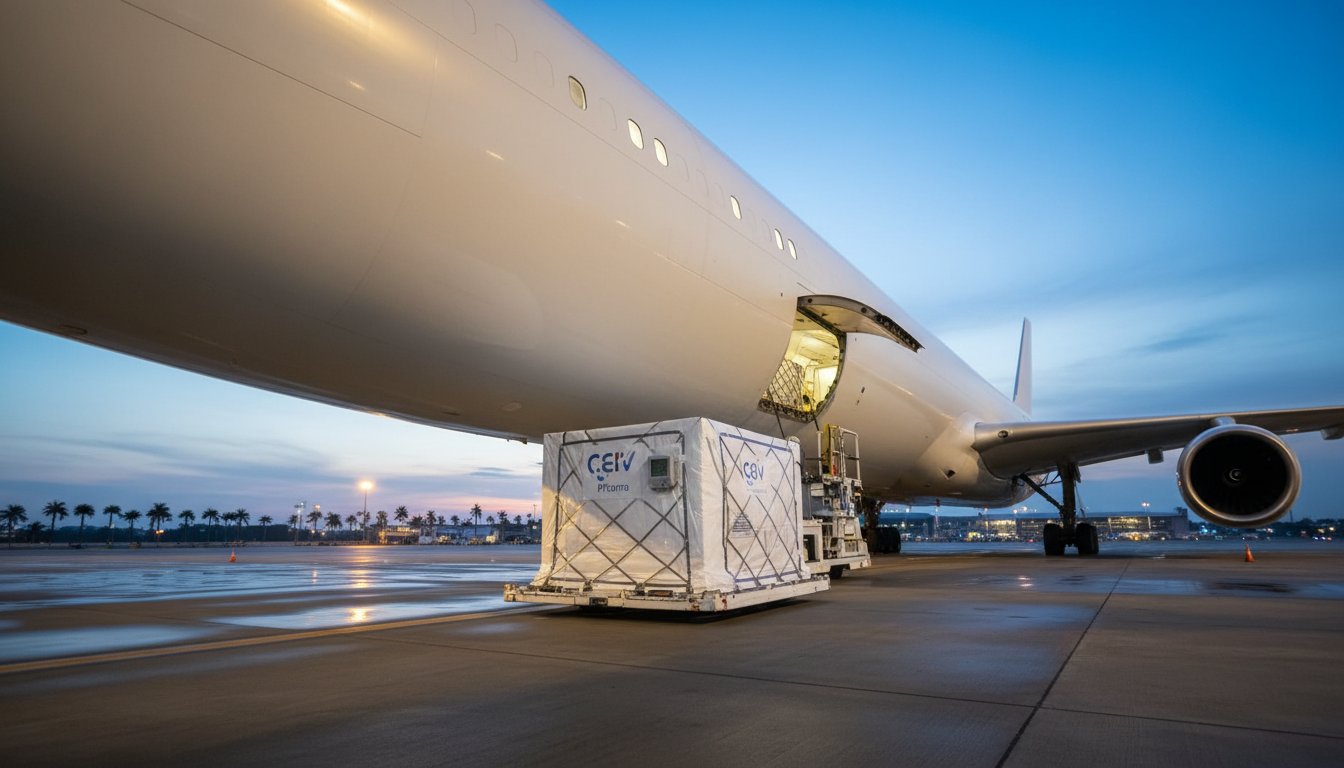
| Pharmaceuticals (cold chain) | Vaccines, biologics, insulin, certain antibiotics | Chilled (2°C to 8°C) or frozen (-20°C or below) | Validated reefer containers or passive thermal packaging with temperature data loggers |
| Implantable devices | Pacemakers, stents, orthopaedic implants, cochlear implants | Ambient, sterile, shock-sensitive | Individual sterile packaging in protective cases, anti-static where required |
| Electromedical equipment | Patient monitors, defibrillators, ultrasound probes, surgical instruments | Ambient, shock-sensitive, calibration-sensitive | Custom crates, foam inserts, vibration dampening |
Transit Risk Profile: Pharmaceutical & Medical Devices
The pharmaceutical and medical device industry faces transit risks that combine physical damage sensitivity with regulatory and sterility dimensions not found in other cargo sectors.
| Risk Type | Why Pharma and Medical Devices Are Vulnerable | Coverage Response |
|---|---|---|
| Temperature deviation | Vaccines, biologics, and insulin have strict cold chain requirements. A 30-minute temperature excursion can render a vaccine shipment worthless. Even ambient pharmaceuticals have controlled room temperature requirements (15°C to 25°C) that can be breached in tropical conditions or during port dwell time. | ICC (A) with temperature deviation extension. Continuous temperature monitoring with data loggers is standard. Underwriters may require validated shipping lanes and qualified packaging. |
| Sterility breach | Medical gloves, catheters, syringes, and implantable devices are shipped sterile. Any breach of sterile packaging during transit (puncture, crush, moisture ingress, contamination) renders the product unusable. The goods may appear intact externally but be medically compromised. | ICC (A) covers physical damage including packaging breach. The full value of goods with compromised sterility is claimable, not just the cost of repackaging. Sterile goods with breached packaging cannot be resterilised in transit. |
| Shock and vibration | Diagnostic equipment, imaging components, and electromedical devices contain precision calibrated instruments. Rough handling, container drops, and vessel vibration can displace components and affect calibration without visible external damage. | ICC (A) covers physical damage including internal damage from shock and vibration. Pre-shipment and post-delivery functional testing supports claims. Custom crating with shock indicators provides evidence. |
| Moisture and humidity | Medical gloves deteriorate when exposed to excessive moisture. Pharmaceutical packaging can be compromised by humidity. Container condensation is a particular risk for long-haul ocean transit through tropical zones. | ICC (A) covers moisture damage during transit. Desiccants, moisture barriers, and dry container inspections before loading are standard preventive measures. |
| Regulatory rejection | Destination countries may reject pharmaceutical or medical device shipments that fail inspection, arrive with damaged or illegible labelling, lack required documentation, or show evidence of temperature excursion. FDA (US), CE (EU), TGA (Australia), and other regulatory authorities have the power to reject shipments at the border. | Regulatory rejection is not a standard covered peril under ICC (A). Rejection extensions are available and recommended for this industry. The cost of re-exporting or destroying rejected pharmaceuticals can be significant, particularly for controlled substances. |
| Theft | Pharmaceutical products have high black market value. Medical devices, particularly high-value implantables and diagnostic equipment, are theft targets. Theft from containers, warehouses, and during last-mile delivery is a documented risk. | ICC (A) covers theft. Security measures (GPS tracking, tamper-evident seals, vetted carriers, secure warehousing) are underwriting considerations. |
| Contamination | Chemical contamination from adjacent cargo or container residues. Pharmaceutical products are regulated goods: any contamination, even if the product is physically unaffected, may trigger a recall obligation. | ICC (A) covers contamination during transit. Dedicated containers (not shared with chemical or non-pharmaceutical cargo) and pre-loading container inspection are standard requirements. |
| Counterfeiting and tampering | The pharmaceutical supply chain is targeted by counterfeit and tampering operations. While this is primarily a supply chain security issue, transit is a vulnerability point. | Not a standard cargo insurance peril. Supply chain security (serialisation, tamper-evident packaging, track-and-trace) is the primary defence. Cargo insurance covers the physical goods, not the reputational or recall costs from a tampering event. |
Insurance Programme for Pharmaceutical & Medical Device Exporters
| Coverage | What It Covers | Why This Industry Needs It |
|---|---|---|
| Marine cargo open cover (ICC (A)) | All-risks coverage for all shipments during the policy year. Warehouse-to-warehouse, all modes. | Medical device and pharmaceutical exporters ship regularly to multiple markets. An open cover provides automatic coverage with monthly declarations. |
| Temperature deviation extension | Covers loss or damage from mechanical or electrical failure of the refrigeration or temperature-control system. | Any exporter shipping cold chain pharmaceuticals (vaccines, biologics, insulin) or temperature-sensitive medical devices requires this extension. |
| War risk extension | Institute War Clauses (Cargo). | Pharmaceutical supply chains reach conflict-affected regions and pass through JWC listed areas. Humanitarian and government health programme shipments may go to high-risk destinations. |
| Strikes extension | Institute Strikes Clauses (Cargo). | Port strikes can delay pharmaceutical shipments beyond their shelf life or temperature stability window. |
| Rejection extension | Covers financial loss when goods are rejected at the destination port by regulatory authorities (FDA, CE marking authorities, TGA, etc.). | Pharmaceutical and medical device imports face stringent regulatory inspection. A rejection extension covers re-export costs, destruction costs, or diversion expenses. |
| Freight forwarder's liability | Covers the forwarder's legal liability for loss or damage to goods in their care. | GDP-compliant logistics providers handling pharmaceutical cargo face specific liability if temperature control, handling, or documentation failures occur during their portion of the transit. |
| Terminal operator's liability | Covers loss or damage to goods while in the terminal operator's care. | Pharmaceutical products dwell at port terminals and bonded warehouses. Power failures affecting cold storage at these points are the terminal operator's liability. |
→ Learn more about open cover marine cargo insurance → Learn more about specialist and high-value transit cover → Learn more about freight forwarder's liability insurance
Trade Corridors for Malaysian Pharmaceutical & Medical Device Exports
| Corridor | Key Ports | What Ships | Risk Factors | Notes |
|---|---|---|---|---|
| Malaysia to United States | Port Klang, Penang → Long Beach, Savannah, Houston | Rubber gloves (36.9% of exports), catheters, syringes, diagnostic kits | Transpacific transit (20 to 30 days). US FDA import inspection and facility registration requirements. US tariff exposure (medical devices and pharmaceuticals subject to evolving trade policy). | The US is Malaysia's largest medical device export market by value. Surgical and examination gloves alone accounted for RM5.01 billion in US-bound exports in 2024. |
| Malaysia to Europe | Port Klang, Tanjung Pelepas → Rotterdam, Hamburg, Felixstowe | Catheters, medical consumables, gloves, pharmaceutical products | Transit 18 to 25 days via Suez. CE marking and EU MDR (Medical Device Regulation) compliance required. Temperature management for pharmaceutical shipments. | EU market requires MDR compliance since May 2021. Malaysian manufacturers must ensure their devices meet the updated classification and documentation requirements. |
| Malaysia to Japan | Port Klang, Penang → Yokohama, Osaka, Kobe | Medical devices, gloves, catheters, diagnostic equipment | Transit 10 to 14 days. PMDA (Pharmaceuticals and Medical Devices Agency) registration required. Strict quality inspection at port of entry. | Japan has demanding quality standards. Cosmetic packaging defects that would be acceptable elsewhere may trigger rejection in Japan. |
| Malaysia to China | Port Klang, Penang → Shanghai, Shenzhen, Tianjin | Gloves, medical consumables, pharmaceutical ingredients | Transit 5 to 10 days. NMPA (National Medical Products Administration) registration. Import licence requirements. Growing market for Malaysian medical consumables. | China is an increasingly important destination as its healthcare spending grows. |
| Malaysia to ASEAN | Port Klang, Penang → Bangkok, Jakarta, Manila, Ho Chi Minh City, Singapore | Medical consumables, gloves, pharmaceutical products | Short transit (2 to 7 days). Each ASEAN country has its own medical device registration authority. Singapore serves as a regional distribution hub. | Intra-ASEAN medical device trade benefits from ASEAN Medical Device Directive harmonisation, though registration requirements still vary by country. |
| Malaysia to Middle East | Port Klang → Jebel Ali, Riyadh, Jeddah | Medical consumables, pharmaceutical products, gloves | Transit 12 to 18 days. GCC conformity requirements. High ambient temperatures at destination require attention to temperature-sensitive products. | Growing healthcare infrastructure investment in GCC countries drives demand. |
| Malaysia to Africa | Port Klang → Mombasa, Lagos, Dar es Salaam, Durban | Medical gloves, syringes, basic diagnostic equipment, pharmaceutical products | Transit 14 to 25 days. Port congestion. Extended customs clearance. Higher pilferage risk. Limited cold chain infrastructure at some destinations. | Healthcare system development and government procurement programmes drive demand. Cold chain integrity is the primary concern for pharmaceutical shipments. |
Who In the Pharmaceutical & Medical Devices Industry Needs Marine Insurance
| Audience | Insurance Need | Primary Product |
|---|---|---|
| Medical glove manufacturers | Coverage for high-volume outbound shipments of rubber and nitrile gloves. Full container loads to multiple global markets. Moisture and sterility protection are key. | Open cover marine cargo |
| Catheter and medical tubing manufacturers | Coverage for sterile medical devices where packaging integrity equals product integrity. A crushed carton is not cosmetic damage; it is a sterility breach. | Open cover marine cargo |
| Pharmaceutical manufacturers | Coverage for ambient and cold chain pharmaceutical products. Temperature deviation extension for biologics and vaccines. Rejection extension for markets with strict import inspection. | Open cover marine cargo with temperature and rejection extensions |
| Diagnostic equipment manufacturers | Coverage for precision instruments sensitive to shock, vibration, and moisture. High per-unit value. Custom crating requirements. | Open cover marine cargo or single shipment for high-value equipment |
| Implantable device manufacturers | Coverage for pacemakers, stents, orthopaedic implants, and other high-value sterile devices. Zero tolerance for damage or sterility compromise. | Open cover marine cargo |
| Contract manufacturers and CMOs | Coverage for outbound shipments on behalf of brand owners. Multiple products, multiple destinations, variable Incoterms depending on each contract. | Open cover marine cargo |
| GDP-compliant logistics providers | Liability coverage for pharmaceutical and medical device cargo in your care. GDP (Good Distribution Practice) compliance creates a higher standard of care and a corresponding liability exposure. | Freight forwarder's liability |
| Government and NGO procurement agents | Coverage for medical supply shipments to healthcare programmes, often to challenging destinations with limited logistics infrastructure. | Single shipment cover or open cover depending on volume |
Common Claims in the Pharmaceutical & Medical Devices Industry
Scenario 1: Sterility Breach on Catheter Shipment
A Malaysian catheter manufacturer ships 50,000 units of sterile urinary catheters from Penang to a hospital group in Germany. During container handling at the transhipment port in Singapore, a forklift tine punctures three cartons near the base of the container stack. The external cartons are damaged, and the sterile barrier packaging on approximately 2,000 catheters is compromised.
| Component | Detail |
|---|---|
| Commodity | Sterile urinary catheters (50,000 units) |
| Corridor | Penang to Hamburg, Germany (transhipment via Singapore) |
| Cause of loss | Forklift tine puncture during container handling at transhipment port |
| Damage | 2,000 units with compromised sterile packaging. Devices are physically intact but cannot be used in a medical setting with breached sterility. |
| Claim value | USD 48,000 (value of 2,000 compromised units; remaining 48,000 units are unaffected) |
| Coverage response | ICC (A) covers physical damage during transit, including handling damage at ports and transhipment points. The full value of the sterility-compromised units is claimable. |
| Key consideration | The insurer may pursue subrogation against the port terminal operator for the forklift damage. The German hospital group's receiving inspection identified the damage; if the compromised units had been distributed, the recall costs would have been significantly higher. |
Scenario 2: Temperature Excursion on Vaccine Shipment
A pharmaceutical company ships a reefer container of vaccines from Port Klang to Lagos, Nigeria, for a government health programme. The vaccines must remain between 2°C and 8°C throughout transit. During a 3-day port dwell at an intermediate stop, the container is disconnected from power due to a port equipment failure. The temperature data logger records a sustained excursion to 18°C over 14 hours. The World Health Organization's vaccine management protocols require destruction of the entire consignment.
| Component | Detail |
|---|---|
| Commodity | Vaccines (reefer container, 2°C to 8°C requirement) |
| Corridor | Port Klang to Lagos, Nigeria (intermediate stop) |
| Cause of loss | Power disconnection at intermediate port, sustained temperature excursion to 18°C for 14 hours |
| Damage | Entire consignment (USD 420,000) must be destroyed per WHO protocols. Vaccines that have breached the cold chain cannot be administered. |
| Claim value | USD 420,000 plus destruction costs |
| Coverage response | ICC (A) with temperature deviation extension covers the loss. Temperature data logger provides evidence of the excursion and its cause. |
| Key consideration | The insurer may pursue subrogation against the port authority for the power disconnection. The government health programme faces a supply disruption. Replacement lead time for vaccines may be 8 to 12 weeks. |
Scenario 3: Moisture Damage to Medical Gloves During Monsoon Season
A Malaysian rubber glove manufacturer ships 10 containers of examination gloves from Port Klang to Long Beach, California. The transpacific voyage takes 25 days. On arrival, the buyer's receiving inspection finds moisture damage in two containers: cartons on the upper layer are damp, and gloves in those cartons show surface tackiness and discolouration. Container inspection reveals condensation damage and evidence of a hatch cover seal leak during heavy weather.
| Component | Detail |
|---|---|
| Commodity | Examination gloves (10 containers, 2 affected) |
| Corridor | Port Klang to Long Beach, California |
| Cause of loss | Moisture ingress from hatch cover seal failure during heavy weather, compounded by container condensation over 25-day transpacific transit |
| Damage | Surface tackiness and discolouration on gloves in upper-layer cartons of 2 containers. Affected gloves fail quality inspection and are rejected by the buyer. |
| Claim value | USD 135,000 (estimated value of affected gloves in 2 containers) |
| Coverage response | ICC (A) covers water damage and moisture damage during transit. The claim is valid. |
| Key consideration | The insurer may pursue subrogation against the shipping line for the hatch cover failure. The glove manufacturer should document container condition before loading (pre-trip inspection) and use moisture barriers and desiccants for long-haul ocean transit. The 8 unaffected containers are not part of the claim. |
Incoterms and Pharmaceutical & Medical Device Trade
Pharmaceutical and medical device trade has specific Incoterms patterns driven by regulatory requirements, cold chain responsibility, and the high compliance burden that falls on whichever party controls the import process.
| Incoterm | Common in Pharma/Med Device Trade? | Who Arranges Insurance | Notes for This Industry |
|---|---|---|---|
| CIF (Cost, Insurance, Freight) | Common for medical device exports to developing markets | Seller arranges insurance to destination port. CIF requires ICC (C) minimum under Incoterms 2020. | CIF is standard when the Malaysian manufacturer is more sophisticated than the buyer and manages the shipping arrangement. For cold chain shipments, the buyer should verify that the seller's insurance includes temperature deviation coverage, as ICC (C) does not. |
| FOB (Free on Board) | Common for large buyers with their own logistics | Buyer arranges insurance from port of loading. | Common when the buyer is a large hospital group, government procurement agency, or multinational distributor with established freight and insurance arrangements. |
| CIP (Carriage and Insurance Paid To) | Increasingly common for door-to-door pharmaceutical shipments | Seller arranges insurance to named destination. CIP requires ICC (A) under Incoterms 2020. | CIP's ICC (A) requirement provides the broadest standard coverage. Well suited for pharmaceutical shipments where the seller manages the cold chain from factory to the buyer's warehouse. |
| DDP (Delivered Duty Paid) | Used for direct sales to healthcare facilities | Seller arranges all insurance and bears all risk until delivery. Seller handles import clearance. | DDP places the regulatory import burden on the seller. This is only practical when the seller has an established presence or a registered agent in the destination country. |
| EXW (Ex Works) | Less common; used for contract manufacturing | Buyer arranges all insurance from the manufacturer's premises. | Common when the buyer is a brand owner collecting product from a contract manufacturer. The brand owner controls the entire supply chain from factory gate. |
| DAP (Delivered at Place) | Growing for e-commerce medical supplies | Seller arranges insurance and delivers to the named place, but the buyer handles import clearance and duty. | Practical when the seller wants to deliver to the buyer's facility but cannot handle import formalities in the destination country. |
Frequently Asked Questions (FAQ)
What type of cargo insurance do medical device exporters need?
An annual open cover under ICC (A) is the standard structure for medical device exporters with regular shipments. The policy should cover all transport modes (sea, air, road) on a warehouse-to-warehouse basis. For cold chain pharmaceutical products, a temperature deviation extension is required. For markets with stringent import inspection (US, EU, Japan), a rejection extension is recommended.
Does cargo insurance cover sterility-compromised medical devices?
Yes. If physical damage during transit (impact, puncture, crush, moisture ingress) compromises the sterile packaging of a medical device, the goods are claimable at their full value under ICC (A). Sterile medical devices with breached packaging cannot be resterilised in the field and are treated as total losses, even if the device inside appears physically intact.
Is GDP (Good Distribution Practice) compliance relevant to cargo insurance?
GDP compliance is not a cargo insurance requirement, but it affects the risk profile. Logistics providers who are GDP-compliant follow validated processes for temperature control, storage, and handling of pharmaceutical products. Underwriters may offer better terms for shipments handled through GDP-compliant supply chains because the risk of temperature deviation and handling damage is lower.
How does temperature monitoring support a cargo insurance claim?
Continuous temperature data loggers record the temperature throughout transit. If a temperature excursion occurs, the data log provides evidence of when it started, how long it lasted, and how severe it was. This evidence supports the claim by establishing the cause and extent of the loss. Underwriters may require temperature monitoring as a condition of cover for cold chain shipments.
Does cargo insurance cover the cost of a product recall triggered by transit damage?
Standard marine cargo insurance covers the physical loss or damage to the goods in transit. It does not cover the downstream costs of a product recall (notification, retrieval, investigation, reputational damage). Product recall insurance is a separate coverage line. Cargo insurance covers the value of the damaged goods, not the consequences of damaged goods entering the supply chain.
Are high-value implantable devices covered under a standard open cover?
It depends on the per-shipment limit and commodity scope of your open cover. Pacemakers, stents, and orthopaedic implants are high value per unit and may approach or exceed per-shipment limits on standard open covers. Confirm that your open cover's commodity definitions include implantable devices and that the per-shipment limit is adequate. For very high-value shipments, a separate single shipment placement may be appropriate.
What happens if a medical device shipment is rejected by the FDA at the US border?
FDA rejection means the goods cannot enter the US market. They must be re-exported, destroyed, or diverted to another market. Standard ICC (A) does not cover regulatory rejection. A rejection extension, if in place, covers the re-export or destruction costs and may cover the cargo value, subject to policy terms. Without the extension, the financial loss from an FDA rejection is uninsured.
Why Voyage for Pharmaceuticals & Medical Devices
Pharmaceutical and medical device exports carry a dimension of risk that no other cargo sector shares: patient safety. A damaged shipment of medical gloves is not just a financial loss. It is a supply disruption at hospitals that may have no alternative source. A temperature-compromised vaccine consignment is not just a claim. It is a public health programme that loses weeks of coverage.
Voyage arranges marine cargo insurance for medical device manufacturers, pharmaceutical companies, glove producers, catheter exporters, and the GDP-compliant logistics providers who maintain the cold chain and sterility integrity that this industry demands. We understand the specific risks, the regulatory landscape, and the trade corridors that carry Malaysian healthcare products to the US, Europe, Japan, ASEAN, and beyond.
Disclaimer: This page provides general guidance on cargo insurance for the pharmaceutical and medical device industry. Coverage terms, conditions, and availability vary by insurer, policy, and jurisdiction. Regulatory compliance (FDA, CE, TGA, MDA, GDP) is the responsibility of the manufacturer and importer; cargo insurance provides financial protection but does not replace regulatory compliance programmes. Always review your specific policy wording and consult a qualified insurance professional before making coverage decisions.
Our Solutions
| Solution | Description |
|---|---|
| Marine Cargo Insurance | Overview of marine cargo coverage, who needs it, and how Voyage works with cargo owners. |
| Open Cover Marine Cargo | Annual facility covering all shipments. Automatic coverage, monthly declarations, consistent terms. |
| Single Shipment Cover | Ad hoc coverage for individual consignments. High-value equipment, one-off shipments. |
| Specialist & High-Value Transit | Coverage for temperature-sensitive pharmaceuticals and high-value medical devices. |
| Freight Forwarder's Liability | Liability coverage for GDP-compliant logistics providers handling healthcare cargo. |
| Marine Liability Insurance | Terminal operator's liability, cargo legal liability, and E&O cover. |
Insights on Pharmaceutical & Medical Device Cargo
Guidance on insuring healthcare products, cold chain compliance, and regulatory risk across global trade corridors.
Let's Talk About Your Pharmaceutical & Medical Device Shipments
If you manufacture, process, or export pharmaceutical products or medical devices, we can arrange marine cargo coverage designed for the specific risks of the healthcare supply chain, including cold chain protection, sterility integrity, and regulatory compliance.
Voyage is a specialist marine cargo insurance platform arranging coverage for goods in transit worldwide. All insurance is arranged through licensed broking partners. Voyage is not an insurer. Coverage terms, conditions, and availability vary by insurer, policy, and jurisdiction.
Cluster Guides
Pharmaceutical and medical-device imports run on NPRA licensing, GDP distribution rules, and the cold-chain integrity that your placement has to track. These guides walk through the regulatory framework, the cold-chain liability triggers, and the cargo-insurance exclusions that catch pharma buyers out at claim time.
Get a quote, or refer a client
For a marine cargo quote on pharmaceutical and medical-device shipments, send your cargo type, value, and lanes through the quote form for a 24 to 48 hour turnaround, or WhatsApp +60 14 925 5243, subject to policy terms and conditions.
Freight forwarders: Voyage works with forwarders as a referral partner, not a competitor for your freight. Refer a pharmaceutical client for cargo cover placed in their own name, stay in the loop, and keep the relationship. See why cargo insurance referrals protect your business, or explore a partnership via the contact form.
Why Voyage
Marine Insurance Specialists
International Underwriter Access
Both Sides of the Supply Chain
Malaysia and Singapore Expertise
Other industries
Explore other industries we cover


Get Best Rates / Quotation

Voyage is a specialist marine insurance intermediary arranging marine cargo and marine liability coverage for businesses in Malaysia, Singapore, and internationally. All insurance is placed through licensed broking partners.
Riskflow Sdn Bhd (202101001225):
Suite 3.19 (North Block), The Ampwalk, 218 Jalan Ampang, 50450 Kuala Lumpur, Wilayah Persekutuan Kuala Lumpur
t: +60149255243 (Kevin H.)
email: kevin@voyagecover.com