IMDG Code for Malaysian Exporters: How Dangerous Goods Classification Affects Your Cargo Insurance
IMDG Code Amendment 42-24 is mandatory from January 2026. How DG classification and packing groups affect cargo insurance and FFL exposure in Malaysia.
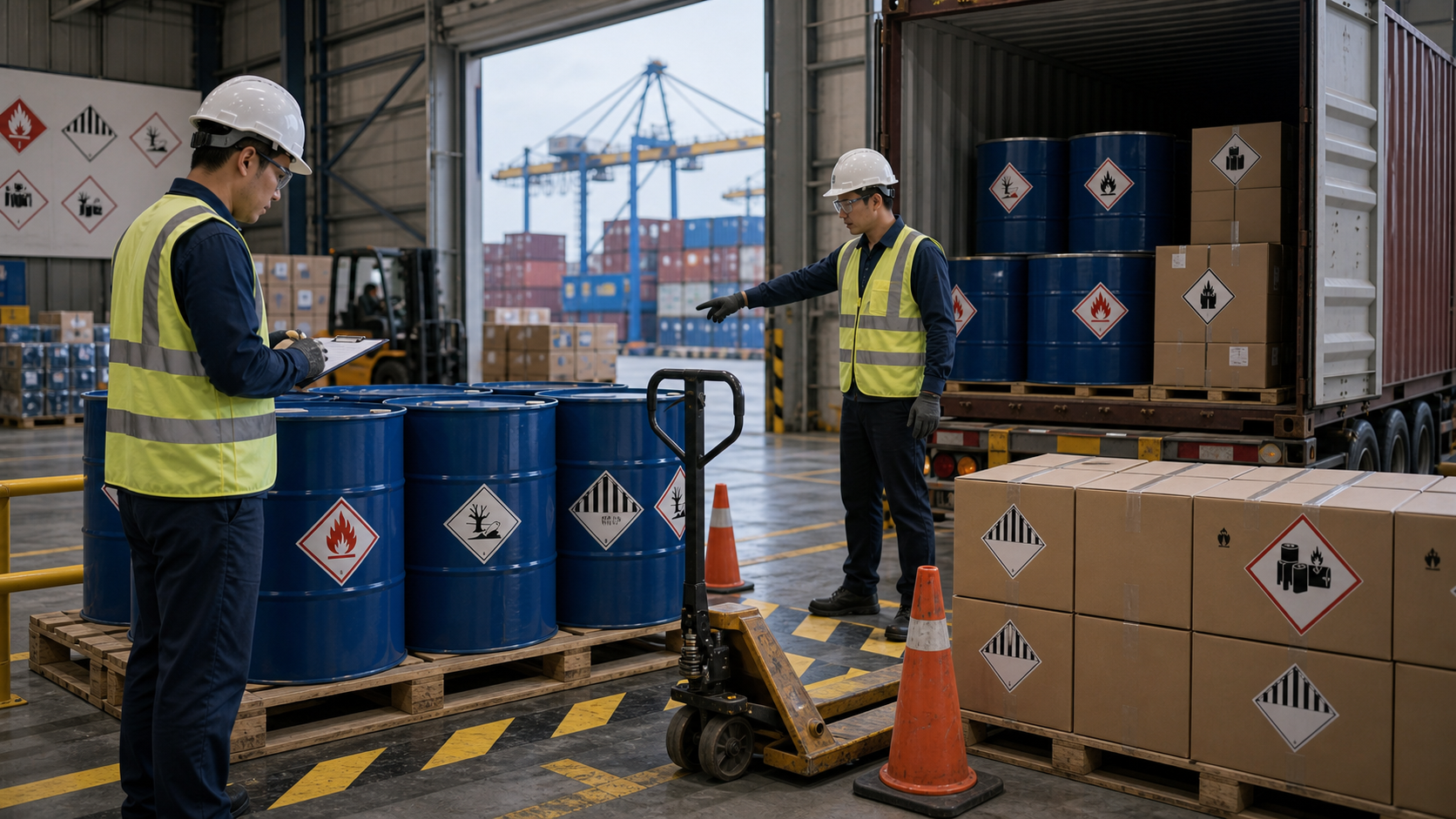
A container of lithium batteries arrives at Port Klang for export. The shipper classified them as UN 3481 (lithium ion batteries packed with equipment), Packing Group II. The freight forwarder filed the Dangerous Goods Declaration on that basis. The batteries should have been classified as UN 3480 (lithium ion batteries, standalone), Packing Group I, with different packing and stowage requirements. The misclassification is discovered at the destination port. The shipment is rejected. The forwarder faces a customs penalty, the shipper faces a cargo claim, and the insurer is reviewing whether the misdeclaration voids the policy.
This scenario plays out regularly in Malaysian trade. Dangerous goods misdeclaration is one of the leading causes of cargo insurance claim denial and one of the most significant liability exposures for freight forwarders.
Key Facts: IMDG Code and Cargo Insurance
What is the IMDG Code? The International Maritime Dangerous Goods Code is the globally accepted regulatory framework for the safe transport of hazardous materials by sea, published by the International Maritime Organization (IMO) and mandatory under the SOLAS Convention. It covers classification, packaging, labelling, documentation, and stowage of dangerous goods.
What is Amendment 42-24? Amendment 42-24 is the 2024 edition of the IMDG Code, adopted by the IMO Maritime Safety Committee at its 108th meeting in May 2024. It was voluntarily applicable from 1 January 2025 and became mandatory on 1 January 2026. Key changes include new entries for sodium ion batteries, revised requirements for carbon products, and updated special provisions for lithium batteries.
How does DG classification affect cargo insurance? Incorrect classification of dangerous goods can void a cargo insurance policy. Under standard policy terms, the assured has a duty of disclosure. If hazardous cargo is misdeclared or undeclared, the insurer may decline a claim on the grounds that the risk presented was materially different from the risk insured.
How does DG classification affect forwarder liability? A freight forwarder who files a Dangerous Goods Declaration based on incorrect shipper information faces potential liability under the FMFF Standard Trading Conditions (Clause 6.1-6.3), customs penalties, and professional negligence claims. The forwarder's FFL policy may not cover E&O-type losses arising from documentation errors.
The Nine IMDG Hazard Classes
Every dangerous good shipped by sea must be classified into one of nine hazard classes based on its primary danger. Classification determines every subsequent decision: packaging, labelling, segregation, stowage, and documentation.
| Class | Hazard | Malaysian Export Examples |
|---|---|---|
| 1 | Explosives | Industrial detonators, fireworks |
| 2 | Gases | Compressed industrial gases, aerosol products |
| 3 | Flammable liquids | Paints, solvents, petroleum products |
| 4 | Flammable solids, spontaneous combustion, water-reactive | Charcoal, activated carbon, certain metal powders |
| 5 | Oxidising substances and organic peroxides | Ammonium nitrate fertilisers, hydrogen peroxide |
| 6 | Toxic and infectious substances | Pesticides, medical waste, certain chemicals |
| 7 | Radioactive material | Medical isotopes, industrial radiography sources |
| 8 | Corrosives | Sulphuric acid, batteries (wet), cleaning chemicals |
| 9 | Miscellaneous dangerous goods | Lithium batteries, sodium ion batteries (new under Amendment 42-24), environmentally hazardous substances |
Classification is the shipper's legal responsibility. The shipper provides the UN number, proper shipping name, hazard class, packing group, and any special provisions. The freight forwarder files the Dangerous Goods Declaration based on the shipper's information. If the shipper's classification is wrong, both the shipper and the forwarder face exposure.
Amendment 42-24: What Changed for Malaysian Exporters
The IMDG Code Amendment 42-24, mandatory from 1 January 2026, introduces changes that affect several commodity groups significant to Malaysian trade.
Carbon products. Carbon blacks and charcoal can no longer be exempted from the IMDG Code under previous provisions. They now require specific weathering documentation, transport conditions, and packing instructions. Malaysian exporters of activated carbon and charcoal products need to update their classification and documentation.
Sodium ion batteries. Amendment 42-24 introduces official classification for sodium ion batteries in Class 9, with entries paralleling lithium battery requirements. As electronics and semiconductor exports from Malaysia increasingly include battery-powered devices, the distinction between lithium and sodium ion battery classification becomes operationally important.
Ammonium nitrate fertilisers. Revised requirements for ammonium nitrate-based fertilisers affect stowage and segregation. Malaysian exporters of agricultural chemicals should verify their products against the updated Dangerous Goods List entries.
Labelling for smoke-producing substances. New labelling requirements for smoke-producing substances now highlight potential corrosive or toxic inhalation hazards, requiring updated packaging and marking.
Where the Insurance Bridge Sits
DG misdeclaration creates insurance exposure at three points.
Cargo insurance claim denial. Under a marine open cover policy, the assured warrants that all shipment details are declared accurately. If dangerous goods are misdeclared, the insurer may argue that the risk presented was materially different from the risk insured. The policy terms require the assured to declare every consignment, and the basis of valuation assumes accurate description of the cargo. A misdeclared DG shipment may fall outside the scope of the cover entirely.
Forwarder liability. Under FMFF STC Clause 6.1, the customer "shall be deemed to have truthfully and accurately declared all particulars relating to the general nature and description of the goods." Under Clause 6.2, the customer "shall be liable for all loss or damage, costs, expenses and any fines or charges imposed by the authority resulting from the inaccurate, fraudulent or incomplete information." But the forwarder is not automatically protected. Under Clause 6.3, if the forwarder becomes liable to a third party due to inaccurate information, the customer must indemnify the forwarder. This indemnity is only as good as the customer's ability to pay.
Third-party claims. If misdeclared DG causes a fire, explosion, or contamination affecting other cargo on the vessel, the shipper and potentially the forwarder face third-party claims from other cargo interests, the vessel owner, and port authorities. These claims can be orders of magnitude larger than the value of the misdeclared cargo itself.
For Malaysian forwarders handling DG shipments, the intersection of cargo insurance and freight forwarder's liability is where the exposure concentrates. A standard FFL policy covers cargo damage from handling errors. It may not cover the professional negligence of filing a DG declaration based on incorrect shipper information. For forwarders concerned about misdeclaration penalties specifically, our guide on cargo owner's legal liability covers the broader liability landscape.
Documentation Checklist for DG Shipments
Every DG shipment from Malaysia requires the following documentation to be compliant with IMDG Code requirements and to protect the insured status of the cargo:
Dangerous Goods Declaration (DGD). The legal document signed by the shipper confirming classification, UN number, proper shipping name, hazard class, packing group, quantity, and emergency contact. The DGD is the shipper's warranty that the goods are classified and packed according to IMDG Code requirements.
Container/vehicle packing certificate. Confirms that the container was packed in accordance with IMDG Code requirements, including proper segregation, securing, and marking of packages within the container.
Multimodal Dangerous Goods Form (IMO model). Combines the DGD and packing certificate into a single document for multimodal shipments.
Emergency response information. The EmS (Emergency Schedule) guide reference for the specific goods, providing firefighting and spillage response procedures.
MITI Strategic Trade Act permit (where applicable). Some dangerous goods, particularly dual-use chemicals and precursors, also fall under the Strategic Trade Act 2010 and require a MITI export permit in addition to IMDG compliance. The Malaysia export documentation checklist covers the full regulatory stack.
Common Misdeclaration Errors in Malaysian Trade
Based on patterns observed in cargo claims and customs enforcement, the most frequent DG misdeclaration errors from Malaysian export operations include:
Lithium battery misclassification. Confusing UN 3480 (standalone batteries) with UN 3481 (batteries packed with equipment) or UN 3482 (batteries contained in equipment). Each has different packing instructions, quantity limits, and marking requirements. Amendment 42-24 adds sodium ion battery entries that parallel these distinctions.
Undeclared marine pollutants. Some goods classified as dangerous under the IMDG Code are also marine pollutants requiring additional marking and documentation. The marine pollutant designation is frequently missed, particularly for chemical intermediates and industrial cleaning products.
Wrong packing group assignment. The packing group (I, II, or III) determines the packaging standard. A chemical classified as Packing Group I (high danger) requires more stringent packaging than Packing Group III (low danger). Incorrectly assigning a lower packing group reduces packaging requirements and increases risk.
Failure to update for Amendment 42-24. Shippers using classification data from the previous IMDG Code edition (Amendment 41-22) may find that entries have changed, special provisions have been added, or exemptions have been removed. Using outdated classifications is non-compliant from 1 January 2026.
Get a tailored quote. WhatsApp Kevin at +60 19 990 2450 or request a callback.
Frequently Asked Questions
Can my cargo insurance claim be denied if dangerous goods are misdeclared?
Yes. Misdeclared DG means the insurer was not informed of the true risk. The claim may be declined on the grounds of material non-disclosure.
Who is responsible for DG classification: the shipper or the freight forwarder?
The shipper has primary legal responsibility. The forwarder files the DGD based on shipper information but may face liability for accepting obviously incorrect data.
When did IMDG Code Amendment 42-24 become mandatory?
It became mandatory on 1 January 2026, per IMO Maritime Safety Committee adoption.
Does the FMFF STC protect the forwarder from DG misdeclaration claims?
Partially. The customer must indemnify the forwarder under Clauses 6.1-6.3, but this depends on the customer's financial capacity, and the forwarder may still face third-party claims.
Do lithium batteries require IMDG Code classification?
Yes. Lithium batteries are Class 9 under IMDG. UN 3480, 3481, and 3482 cover different configurations. Amendment 42-24 adds sodium ion battery entries.
Are there additional Malaysian regulatory requirements for exporting dangerous goods?
Some DG items fall under the Strategic Trade Act 2010, requiring MITI permits. IMDG and STA compliance are separate requirements that may apply to the same shipment.
Compliance-Ready Cargo Cover from Voyage
Voyage is a specialist marine insurance intermediary that places cargo cover for Malaysian exporters handling dangerous goods. DG shipments require specialist underwriting: the right clause set, accurate commodity declaration, and coverage that responds when the goods are properly classified. Voyage works with underwriters experienced in DG cargo to structure cover that matches the risk.
Get a tailored quote. WhatsApp Kevin at +60 19 990 2450 or request a callback. Quotes turn around in 24-48 hours where the underlying cover is in place.
Disclaimer: This article provides general guidance on IMDG Code compliance and cargo insurance as of June 2026. Coverage terms, conditions, and availability vary by insurer, policy, and jurisdiction. Always review your specific policy wording and consult a qualified insurance professional before making coverage decisions.
Why Voyage
Marine Insurance Specialists
International Underwriter Access
Both Sides of the Supply Chain
Malaysia and Singapore Expertise
Other industries
Explore other industries we cover


Get Best Rates / Quotation

Voyage is a specialist marine insurance intermediary arranging marine cargo and marine liability coverage for businesses in Malaysia, Singapore, and internationally. All insurance is placed through licensed broking partners.
Riskflow Sdn Bhd (202101001225):
Suite 3.19 (North Block), The Ampwalk, 218 Jalan Ampang, 50450 Kuala Lumpur, Wilayah Persekutuan Kuala Lumpur
t: +60149255243 (Kevin H.)
email: kevin@voyagecover.com