Export Documentation Checklist for Malaysian Exporters
Complete Malaysia export documentation checklist: commercial, transport, regulatory, insurance. K2, LC, EUDR, COO, MITI, phytosanitary.
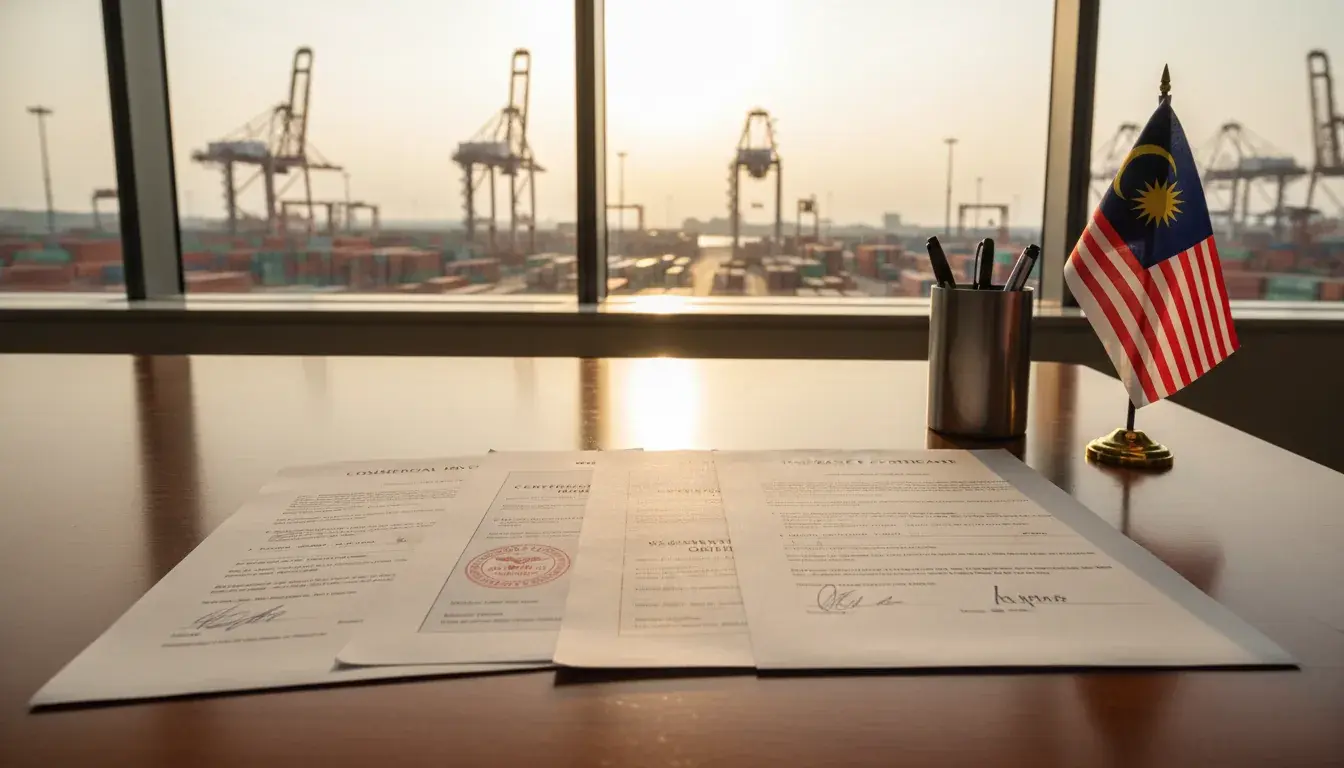
A Malaysian export shipment typically requires between 8 and 15 documents depending on destination, Incoterm, and payment method. Miss one at origin and your container may sit at destination port for days while the issue is resolved, with demurrage running and transit risk still live. Get them all right and the cargo moves cleanly through customs, through the bank under LC, and into the consignee's warehouse.
This checklist is organised the way export coordinators actually work: commercial documents first (what the buyer needs to receive goods), then transport documents (what the carrier and destination customs need), then regulatory documents (what Malaysian and destination authorities require), then financial and insurance documents (what banks and underwriters expect). Within each group, the documents are ordered by how often they apply.
Key Facts: Malaysian Export Documentation
What is the minimum document set for a Malaysian commercial export? Commercial invoice, packing list, Customs K2 export declaration filed through the uCustoms system, and the relevant transport document (bill of lading for ocean, air waybill for air). This four-document core applies to every shipment and grows with destination requirements, commodity regulation, and payment method.
Where is the K2 filed? Through uCustoms, the Royal Malaysian Customs Department (JKDM) electronic system. K2 is required for every commercial export from Malaysia.
Who issues a Certificate of Origin under a free trade agreement? MITI-designated issuers for preferential COs under agreements such as RCEP, CPTPP, AANZFTA, and Malaysia's bilateral FTAs; MATRADE and accredited Chambers of Commerce for non-preferential COs.
What insurance document does an LC require? Under UCP 600 Article 28, published by the International Chamber of Commerce, an insurance document (typically a marine cargo insurance certificate) sum insured at the CIF or CIP value plus 10% in the currency of the LC, with clauses matching the LC terms, dated no later than the date of shipment, subject to policy terms and conditions.
Which commodities need EUDR compliance? Palm oil, rubber, timber, cocoa, coffee, cattle, and soya and their derivatives bound for EU destinations under the EU Deforestation Regulation.
For the foundational cargo insurance explainer, see what marine cargo insurance covers.
Resource: Malaysia Customs Declaration Explained
Download the Malaysia Customs Declaration Explained brief for the K-form and uCustoms reference.
Commercial Documents
The first group of documents describes the commercial transaction itself. They travel with the shipment and are the basis for customs declarations, LC presentation, and consignee receipt.
| Document | Issued by | Purpose |
|---|---|---|
| Commercial Invoice | Exporter | Price, description, Incoterm, currency, buyer and seller details |
| Packing List | Exporter | Package count, gross and net weight, dimensions, piece detail |
| Sales Contract or Purchase Order | Negotiated between buyer and seller | Underlying contract, referenced by other documents |
| Pro Forma Invoice | Exporter, at quotation stage | Buyer's basis for opening LC, applying for import licence, arranging funds |
The Incoterm stated on the commercial invoice must match the Incoterm in the sales contract and must reference the current edition: "CIF Hamburg, Incoterms 2020" not "CIF Hamburg" alone. The Incoterms 2020 rules, published by the International Chamber of Commerce, were updated from the 2010 edition with material changes including the minimum insurance level under CIP (now ICC (A), up from ICC (C)). Where the invoice is ambiguous on Incoterm version, disputes over risk transfer become harder to settle.
For the full Incoterms treatment, see our guide on Incoterms 2020 insurance responsibility.
For ongoing export programmes shipping under repeat commercial invoices and LCs, Marine Cargo Open Cover is the structure that holds; for one-off or occasional consignments, Marine Cargo Insurance is the right fit. For LC-presentation-time insurance checks, see the LC Insurance Certificate Compliance Checklist. Read more on Manufacturing & Industrial Exports Cargo Insurance.
Transport Documents
Transport documents are issued by the carrier or the forwarder and evidence the contract of carriage. They travel with the cargo and control release at destination.
| Document | Issued by | Purpose |
|---|---|---|
| Bill of Lading (ocean) | Shipping line or forwarder | Evidence of carriage, title document, release control |
| Air Waybill (air) | Airline or air forwarder | Evidence of air carriage; not a title document |
| Multimodal Transport Document | Forwarder acting as principal | Door-to-door movement, typically FIATA FBL |
| Booking Confirmation | Carrier or forwarder | Evidence of space allocation, cut-off times, vessel details |
The bill of lading description of goods matters more than many exporters realise. Under the Hague-Visby Rules, carrier liability is capped at SDR 666.67 per package or 2 SDR per kilogramme of gross weight, whichever is higher. A bill of lading that describes the cargo as "1 x 40' container STC 100 cartons" treats the container as 100 packages; one that describes it as "1 x 40' container, goods in bulk" may be treated as 1 package. The difference can be two orders of magnitude in the event of a recovery from the carrier.
See our guide on carrier liability limits for the full treatment of what the shipping line actually owes you.
Regulatory Documents
Regulatory documents are required by Malaysian authorities at export, by destination authorities at import, or by both. Which apply depends on the commodity, the destination, and any free trade agreements in play.
Malaysian Export-Side Documents
| Document | Issued by or filed with | When it applies |
|---|---|---|
| Customs K2 Export Declaration | Royal Malaysian Customs (JKDM) | Every commercial export |
| MITI Export Licence | Ministry of Investment, Trade and Industry | Strategic items under Strategic Trade Act 2010 or specific commodity controls |
| Certificate of Origin (non-preferential) | MATRADE or Chambers of Commerce | Destination customs clearance where origin is required |
| Certificate of Origin (preferential / FTA) | MITI-designated issuers for RCEP, CPTPP, AANZFTA, bilateral FTAs | To claim preferential tariff at destination under FTA |
| Phytosanitary Certificate | Department of Agriculture Malaysia | Plants, plant products, agricultural commodities |
| Halal Certificate | JAKIM or recognised halal certification bodies | Halal-sensitive food, beverages, personal care exports |
| SIRIM Certification or COA | SIRIM QAS International or nominated lab | Product standard certifications, testing results where destination requires |
The K2 form is the standard customs export declaration filed through the uCustoms system. MITI licences apply to strategic items (dual-use goods, certain electronics, chemical precursors) under the Strategic Trade Act 2010 and to specific commodity-controlled items under Ministry-specific rules.
Destination-Side Documents
| Document | When it applies |
|---|---|
| EUDR Due Diligence Statement (DDS) | EU imports of palm oil, rubber, timber, cocoa, coffee, cattle, soya and derivatives; under the EU Deforestation Regulation |
| US Importer Security Filing (ISF 10+2) | Filed 24 hours before loading on US-bound ocean containers |
| Destination-specific import licences and permits | Commodity and destination dependent; buyer is responsible for arranging |
| Inspection certificate (SGS, Bureau Veritas, Intertek) | Where buyer or LC requires pre-shipment inspection |
EUDR is a live compliance requirement for Malaysian palm oil, rubber, and timber exporters shipping to EU destinations. Non-compliance leads to market access issues and potential seizure at destination. For the deep-dive on the compliance framework, see our guide on EUDR compliance for Malaysian palm oil and rubber exporters.
Insurance and Financial Documents
Insurance and financial documents close the export transaction commercially. They are required for LC presentation, for customs valuation, and for the insurance cover that protects the cargo in transit.
| Document | Issued by | Purpose |
|---|---|---|
| Marine Cargo Insurance Certificate | Insurer or broker | Evidence of cargo cover, required for LC under UCP 600 Article 28 |
| Marine Insurance Policy | Insurer | Full policy wording; typically referenced rather than presented |
| Letter of Credit | Issuing bank (typically at destination) | Payment instrument; dictates documents and timing |
| Bill of Exchange or Draft | Exporter (drawer) | Used for payment under documentary collection or LC |
| Bank Guarantee or Standby LC | Buyer's bank | Used for specific trades where performance or payment security required |
The marine cargo insurance certificate is the document that matters for LC presentation. UCP 600 Article 28, published by the International Chamber of Commerce, governs the form, timing, and coverage requirements of the insurance document under LC transactions. The certificate must show cover at least equal to the CIF or CIP value of the goods plus 10%, in the currency of the LC, with clauses matching the LC terms, and must be dated no later than the date of shipment.
For the full walk-through of LC insurance certificate requirements, see our guide on LC insurance certificate requirements.
Documentation Sequencing and Timing
Documents do not issue in one go. The sequence matters: some must be ready before the shipment moves, others issue on shipment date, and a few can follow within a specified window.
| Stage | Documents | Timing |
|---|---|---|
| Pre-shipment (buyer side) | Pro forma invoice, LC, bank guarantee | Weeks to months before shipment |
| Pre-shipment (exporter side) | MITI licence, COO application, phytosanitary, inspection | 1 to 3 weeks before shipment |
| Shipment date | Commercial invoice, packing list, K2, B/L, insurance certificate | Day of vessel loading or AWB issuance |
| Post-shipment | LC presentation, courier of originals to consignee | Typically within 21 days of shipment under LC |
LC presentation deadlines are firm. A document set that arrives at the issuing bank after the LC presentation period expires can be rejected, leaving the exporter with a discrepancy to negotiate and potentially triggering payment delay. The insurance certificate specifically must be dated on or before the shipment date; dated later, it is a discrepancy even where cover itself is in force.
The Insurance Bridge
Most document-delay issues at destination ports are paperwork problems, not cargo problems, but when cargo is held pending documentation fixes, transit risk is still running. The transit clause in Institute Cargo Clauses (A) 2009 Clause 8 typically terminates at the earlier of several triggers including 60 days after discharge from the overseas vessel at the final port of discharge. Cargo sitting at destination for an extended period pending documentation resolution can exhaust that 60-day window, leaving the consignee and exporter with uncovered stock.
This is where marine cargo insurance intersects with documentation: a clean document set keeps the cargo moving, keeps the transit clause within its operative window, and keeps the policy responsive. A missing or incorrect insurance certificate under an LC also triggers a document discrepancy, which delays payment even if the goods themselves are on time and undamaged.
Marine cargo insurance arranged under UCP 600 Article 28 compliant terms, with an ICC (A) 2009 clause set where appropriate, and a sum insured of CIF value plus 10% in the LC currency, is the default that meets most LC-backed Malaysian export transactions, subject to policy terms and conditions. See our marine cargo insurance solution page for the product detail and the guide on cargo insurance for Malaysian exporters for the geographic hub.
For LC-presentation-time insurance checks, see the LC Insurance Certificate Compliance Checklist.
Commodity-Specific Documentation Notes
Documentation layering varies by commodity. The following notes apply to the largest export segments from Malaysia:
| Commodity | Additional documents commonly required |
|---|---|
| Palm oil, RBD palm olein, CPO | MPOB export licence, EUDR DDS for EU-bound, ISO tank cleaning certificate |
| Rubber and rubber products | MRB documentation, EUDR DDS for EU-bound, phytosanitary for raw rubber |
| Electronics and semiconductors | MITI strategic trade licence where applicable, manufacturer declarations, FTA COO |
| Food and beverage | Halal certificate where required, health certificate, phytosanitary for plant-origin |
| Chemicals and petrochemicals | MSDS, DG declaration under IMDG Code, UN number packaging certification |
| Machinery and industrial exports | CE marking declarations where EU-bound, SIRIM or equivalent test reports |
Palm oil and rubber exporters face the additional EUDR compliance layer on EU-bound cargo; electronics exporters often need MITI strategic trade licences where the item classification touches the Strategic Trade Act 2010 control list. See our commodity-specific pages: palm oil cargo insurance, electronics and semiconductors cargo insurance, halal and food export cover, rubber and agricultural commodities cover, and manufacturing and industrial exports cover.
Common Documentation Errors That Cause Delays
Five error patterns account for the majority of destination-port delays on Malaysian export shipments.
| Error | Consequence |
|---|---|
| Invoice and packing list quantity mismatch | Destination customs inspection, possible re-examination |
| B/L consignee details not matching LC consignee | LC discrepancy, payment delay, demurrage at destination |
| Insurance certificate dated after shipment | LC discrepancy under UCP 600 Article 28 |
| COO not issued against the correct FTA | Loss of preferential tariff, duty payable at full rate |
| EUDR DDS not submitted or incomplete | Cargo held at EU port of entry pending compliance |
Frequently Asked Questions
Do I need a marine cargo insurance certificate for my LC?
Yes, if the LC requires an insurance document (most LCs for CIF or CIP shipments do). The certificate must comply with UCP 600 Article 28 requirements, including sum insured at CIF value plus 10% in the LC currency, clause set matching the LC, and date of issue no later than the date of shipment, subject to policy terms and conditions.
What is a K2 form?
The K2 is the standard Malaysian customs export declaration, filed through the uCustoms electronic system by the exporter or their appointed forwarder. It covers commercial goods leaving Malaysia for export and is a prerequisite for customs clearance at origin.
When do I need a MITI export licence?
Strategic items under the Strategic Trade Act 2010 (certain dual-use goods, electronics, chemicals) require MITI licensing, as do specific commodity-controlled items under Ministry-specific rules. The MITI Strategic Trade classification lists the controlled items; unlisted commercial goods generally do not require a MITI licence.
Does EUDR apply to all Malaysian exports to the EU?
No, only to specified commodities and their derivatives: palm oil, rubber, timber, cocoa, coffee, cattle, and soya. Exporters of these commodities to EU destinations must submit a Due Diligence Statement (DDS) demonstrating compliance with the deforestation-free and legal-production requirements of the Regulation.
What happens if my insurance certificate does not match my LC terms?
A mismatch creates a discrepancy on LC presentation. The issuing bank may reject the documents, delaying payment until the discrepancy is resolved or the buyer waives it. Common mismatches include wrong sum insured, wrong clause references, wrong currency, or issue date after the shipment date.
How far in advance should I start preparing export documentation?
For routine commodity exports with established buyers and FTA usage, start 2 to 3 weeks before shipment. For new destinations, new commodities, or LC-backed transactions, start 4 to 6 weeks out to allow for licence applications, COO processing, and LC issuance.
Can my freight forwarder prepare all of my export documents?
Most forwarders prepare or arrange the transport documents (B/L, AWB), file the K2, and can arrange the COO and inspection certificates on your behalf. The commercial invoice, packing list, and sales contract remain the exporter's responsibility; the marine cargo insurance certificate is typically arranged directly with the insurer or broker.
Do my export documents affect my cargo insurance claim?
Yes, in two ways. Documentation that demonstrates care of the goods (packing specifications, temperature logs, inspection certificates) supports a claim by evidencing that the loss was not caused by an excluded peril. Documentation issues that delay cargo at destination can exhaust the transit clause window, leaving post-discharge loss outside cover, subject to policy terms and conditions.
Voyage Conclusion
Export documentation is the mechanism that moves goods legally and commercially from a Malaysian warehouse to a destination consignee. A clean document set keeps the cargo moving, keeps the LC presentation clean, and keeps the cargo insurance certificate in force and compliant with UCP 600 Article 28. A missing or incorrect document, whether at origin or at destination, creates delay, exposure, and in the worst cases, uncovered loss.
Share this brief with your finance director or trade compliance lead before the next shipment lands on their desk. Voyage works with Malaysian and Singaporean exporters running ongoing export programmes under Marine Cargo Open Cover and Marine Cargo Insurance. For the corridor-specific industry view, see Manufacturing & Industrial Exports Cargo Insurance. WhatsApp +60 14 925 5243 or use the contact form.
Download the Malaysia Customs Declaration Explained brief
Covers the K-form, uCustoms touch-points, and document sequencing for Malaysian exporters. For LC-presentation-time insurance checks, pair it with the LC Insurance Certificate Compliance Checklist. Download the Malaysia Customs Declaration Explained brief. Free, no signup wall.
Related guides: LC insurance certificate requirements, letter of credit document checklist for Malaysian exporters, Certificate of Origin (Form D, E, AANZ) for Malaysian exporters, Incoterms 2020 and cargo insurance responsibility, marine cargo insurance for Malaysian exporters.
Disclaimer: This article provides general guidance on export documentation for Malaysian exporters as of May 2026. Regulatory requirements, bank document expectations, and destination-country import rules vary and may change.
Always verify current requirements with the relevant Malaysian authority, your buyer's bank, and a qualified trade and insurance advisor before finalising document sets.
Why Voyage
Marine Insurance Specialists
International Underwriter Access
Both Sides of the Supply Chain
Malaysia and Singapore Expertise
Other industries
Explore other industries we cover


Get Best Rates / Quotation

Voyage is a specialist marine insurance intermediary arranging marine cargo and marine liability coverage for businesses in Malaysia, Singapore, and internationally. All insurance is placed through licensed broking partners.
Riskflow Sdn Bhd (202101001225):
Suite 3.19 (North Block), The Ampwalk, 218 Jalan Ampang, 50450 Kuala Lumpur, Wilayah Persekutuan Kuala Lumpur
t: +60149255243 (Kevin H.)
email: kevin@voyagecover.com