Insuring Furniture and Timber Exports from Malaysia: Fire Risk, Packing Standards, and ISPM 15
Cargo insurance for Malaysian furniture and timber exporters. Covers fire risk from finishing chemicals, stacking damage, moisture, and ISPM 15 compliance.
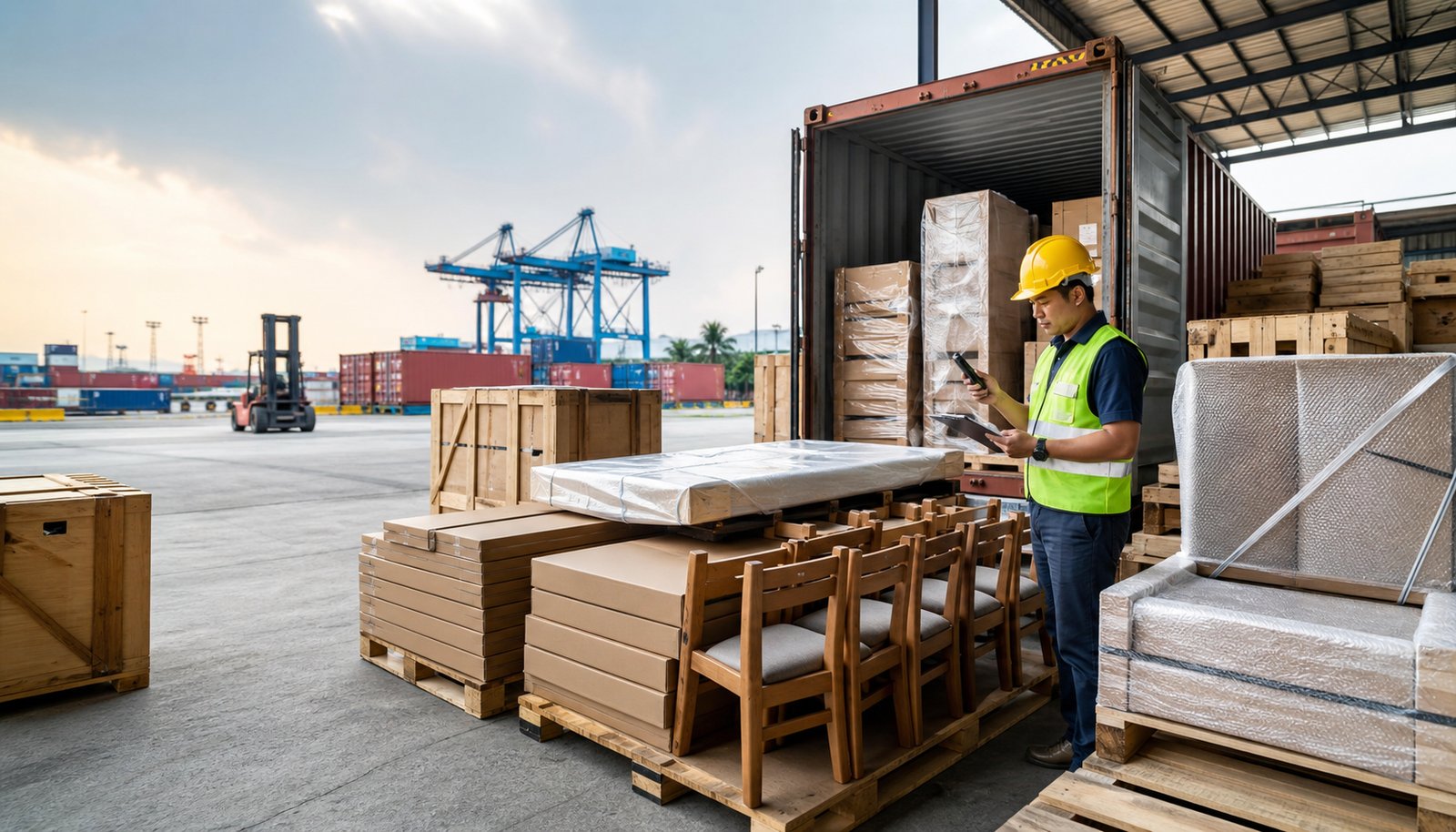
Malaysia exported RM12.83 billion in furniture and furniture parts in 2024 (MITI, 2024), making it a leading furniture exporter in ASEAN and a top-ten exporter globally. The Muar furniture cluster in Johor alone accounts for roughly 60% of that volume, with factories shipping flat-pack dining sets, upholstered sofas, rubberwood bedroom suites, and outdoor teak furniture through Pasir Gudang, Port of Tanjung Pelepas, and Port Klang to buyers across the United States, Japan, the United Kingdom, Australia, and the Middle East.
The cargo risk profile for furniture is more complex than it appears. Lacquers, varnishes, and polyurethane coatings used in finishing lines contain volatile organic compounds that can auto-ignite inside a sealed container on a sun-baked deck. Stacking damage during consolidation breaks legs, cracks tabletops, and tears upholstery fabric. Moisture trapped in insufficiently dried timber warps panels weeks after loading. And non-compliant wood packaging can trigger ISPM 15 rejections at the destination port, leaving goods stranded at the importer's cost or, in some cases, destroyed.
Standard marine cargo insurance covers all of these risks, but only when the right clause set is in place and the exporter's own packing and documentation practices meet underwriter expectations. This is the guide to getting that right.
Key Facts: Furniture Cargo Insurance Malaysia
What does marine cargo insurance cover for furniture exports? Institute Cargo Clauses (A), the broadest standard clause set (IUA/LMA, 2009 edition), covers all risks of physical loss or damage except specific exclusions such as inherent vice, delay, and ordinary wear and tear. For furniture, this includes fire, water damage, breakage during handling, theft, and container damage during transit. ICC (B) and ICC (C) are narrower named-peril covers that may leave stacking damage and moisture claims uninsured.
What is the main transit risk for Malaysian furniture exports? Fire caused by volatile finishing chemicals is the most severe peril. Lacquers, varnishes, and solvent-based coatings emit flammable vapours inside sealed containers, and surface temperatures on container decks can exceed 60 degrees Celsius in equatorial and Middle Eastern transit lanes. Spontaneous ignition of these vapours is a documented cause of container fires at sea.
How does ISPM 15 affect furniture cargo insurance? ISPM 15 (ISPM 15, FAO, 2009, revised 2019) requires all wood packaging materials used in international trade to be heat-treated or methyl bromide fumigated and stamped with the IPPC compliance mark. Non-compliant packaging can lead to cargo rejection, quarantine, or destruction at the destination port. Underwriters may treat ISPM 15 non-compliance as a failure in reasonable care, which can complicate or void a claim for losses arising from that rejection.
What is the standard sum insured for furniture shipments? The market convention is CIF or CIP value plus 10%, calculated as the invoice value of the goods plus freight plus insurance cost, with a 10% uplift to cover incidental costs such as lost profit margin. For high-value bespoke or antique furniture, agreed value policies may be appropriate to avoid under-insurance disputes at claims stage.
Which Incoterms rules place insurance responsibility on the Malaysian exporter? Under CIP (Carriage and Insurance Paid To), the seller must arrange cargo insurance at a minimum of ICC (A) cover (ICC Paris, Incoterms 2020). Under CIF (Cost, Insurance and Freight), the minimum is ICC (C). Furniture buyers in the US and Europe frequently request CIP precisely because it delivers the broader ICC (A) protection by default.
Malaysia's Furniture Export Profile
The Malaysian furniture industry is concentrated in three production zones, each with its own commodity mix and export routing.
| Production Zone | Primary Commodities | Main Export Ports | Key Destination Markets |
|---|---|---|---|
| Muar, Johor (largest cluster) | Flat-pack furniture, dining sets, rubberwood bedroom suites, outdoor furniture | Pasir Gudang, Port of Tanjung Pelepas | United States, Japan, United Kingdom, Australia |
| Klang Valley, Selangor | Office furniture, upholstered sofas, mattresses | Port Klang (Northport, Westport) | Middle East, Singapore, India |
| Sarawak (East Malaysia) | Sawn timber, plywood, timber mouldings, wooden doors and frames | Kuching Port, Sibu Port | Japan, South Korea, Taiwan, India |
Muar's dominance is a geographic moat: the cluster's concentration of rubberwood sawmills, component suppliers, finishing lines, and container freight stations within a 30-kilometre radius means most Johor furniture shipments are stuffed and sealed within hours of final inspection. That proximity reduces but does not eliminate transit risk, because the most dangerous phase for furniture cargo is not the truck ride to Pasir Gudang. It is the 14 to 35 days inside a sealed container on a vessel crossing the equator or transiting the Middle East.
Timber exports from Sarawak, including sawn timber, plywood, and downstream wood products, follow different risk patterns. These are bulk and break-bulk cargoes handled by crane and sling at port, which means mechanical damage during loading and discharge is the primary peril rather than fire. Malaysia exported approximately RM22.9 billion in wood and wood products in 2024 (MITI, 2024), with Sarawak contributing a significant share of sawn timber and plywood volumes.
Transit Risks Specific to Furniture and Timber
Furniture and timber cargoes face five categories of transit risk that underwriters assess when quoting cover. Understanding these risks is also what allows the exporter to pack, document, and declare shipments in a way that supports a clean claim if something goes wrong.
Fire from finishing chemicals
This is the risk that makes furniture a higher-attention commodity class for marine underwriters. Nitrocellulose lacquers, polyurethane varnishes, and solvent-based stains used in the final finishing stage emit volatile organic compounds (VOCs) as residual solvents evaporate. In a sealed 40-foot container sitting on a vessel deck under direct sun, internal temperatures can exceed 60 degrees Celsius. If VOC concentrations in the container headspace reach the lower flammable limit and an ignition source is present (electrical fault, friction, or auto-ignition of certain chemical residues), the result is a container fire.
Container fires at sea are among the most expensive marine casualties. A single container fire can spread to adjacent units and, in worst cases, result in a general average declaration where every cargo interest on the vessel contributes to the common loss under the York-Antwerp Rules 2016.
Underwriters managing furniture accounts will ask about the finishing chemicals used, the drying and curing time between final coat and packing, and whether the factory operates a minimum off-gassing period before container stuffing. Exporters who can document a 48- to 72-hour curing window and provide Safety Data Sheets for their finishing products present a materially better risk profile.
Breakage and stacking damage
Flat-pack furniture is engineered for efficient container loading, but assembled pieces (dining tables, bed frames, display cabinets) are vulnerable to breakage during handling and stacking. Common damage patterns include snapped chair and table legs from vertical stacking pressure, cracked glass tabletops from insufficient edge protection, scratched or dented surfaces from shifting cargo when lashing fails, and torn upholstery from abrasion against container walls or adjacent cartons.
Under Institute Cargo Clauses (A) (IUA/LMA, 2009 edition), breakage from rough handling and stacking failure is covered. Under ICC (B) or ICC (C), many of these damage types fall outside the named-peril lists. For assembled furniture of any value, ICC (A) is the baseline recommendation.
Moisture and condensation damage
Rubberwood, the dominant timber species in Malaysian furniture manufacturing, is kiln-dried to a target moisture content of 8% to 12% before processing. If drying is incomplete or if finished goods absorb ambient moisture before container stuffing (common in Malaysia's 80%+ humidity), the sealed container becomes a moisture trap. As the container transits from tropical to temperate zones, temperature differentials cause condensation on the container ceiling and walls. This "container rain" drips onto cartons and furniture surfaces, causing mould growth on fabric upholstery, warping and delamination of wood panels, and staining and water marks on lacquered surfaces.
Underwriters treat moisture damage claims carefully. If the moisture content of the timber was above specification at the time of stuffing, the underwriter may argue inherent vice, an exclusion under all three ICC clause sets. The exporter's defence is a pre-shipment moisture content certificate from an independent surveyor or the factory's own quality control records showing kiln-drying to specification.
Timber-specific risks: insect infestation and fungal decay
Sawn timber and plywood exports from Sarawak face biological risks that finished furniture does not. Untreated timber can harbour wood-boring insects (powder post beetles, longhorn beetles) and fungal spores that activate during the warm, humid conditions of sea transit. These are inherent vice exclusions under standard ICC clauses if the timber was not properly treated before shipment. Phytosanitary treatment records and a phytosanitary certificate from Malaysia's Department of Agriculture are the documentary evidence that the cargo was fit for transit at the time of loading.
Mechanical damage to timber at port
Sawn timber, plywood bundles, and timber mouldings shipped break-bulk or on flat-racks are handled by crane and sling at origin and destination ports. Sling marks, dropped bundles, fork-truck punctures through plywood packs, and rain damage during open-air port storage are common claim triggers. ICC (A) covers all of these. Port storage extensions may be needed if the cargo is expected to sit in an open yard for more than the standard transit clause duration.
Coverage Response: ICC Clauses and Extensions for Furniture
The standard cargo insurance programme for a Malaysian furniture exporter combines a core clause set with extensions that address the commodity-specific risks above.
| Risk | ICC (A) Cover | ICC (C) Cover | Extension Needed |
|---|---|---|---|
| Fire from finishing chemicals | Covered | Covered (named peril) | None, but underwriter may require finishing chemical disclosure |
| Breakage from handling/stacking | Covered | Not covered | Upgrade to ICC (A) or add breakage extension |
| Moisture and condensation | Covered (if not inherent vice) | Not covered | Moisture content certificate recommended to rebut inherent vice defence |
| Theft of full container | Covered | Not covered | Upgrade to ICC (A) |
| General average contribution | Covered | Covered | None |
| War and strikes | Excluded from ICC (A) | Excluded from ICC (C) | Institute War Clauses (Cargo) CL385 + Institute Strikes Clauses (Cargo) CL386 |
For Muar cluster exporters shipping assembled furniture on FOB or CIF terms, the minimum defensible programme is ICC (A) plus CL385 and CL386. Exporters selling on CIP terms are already required to arrange ICC (A) as the minimum under Incoterms 2020 (ICC Paris, Incoterms 2020).
If the furniture exporter ships regularly (monthly or more frequently), an open cover policy avoids the need to arrange insurance shipment by shipment. Open cover also locks in the clause set and terms for the policy period, which means the exporter does not need to re-negotiate coverage every time a new order ships. For one-off project shipments, such as a bespoke hotel fit-out or exhibition furniture, a single shipment policy is the right structure.
Get a tailored quote. WhatsApp Kevin at +60 14 925 5243 or request a callback.
ISPM 15 Compliance as an Insurance Factor
ISPM 15 (International Standards for Phytosanitary Measures No. 15, FAO, 2009, revised 2019) regulates wood packaging materials in international trade: pallets, crates, dunnage, and any other solid wood used to support or contain cargo during transit. The standard requires all wood packaging to be heat-treated (core temperature of 56 degrees Celsius for 30 minutes) or methyl bromide fumigated, then stamped with the IPPC (International Plant Protection Convention) compliance mark.
This matters for furniture exporters because the packaging around the furniture, not just the furniture itself, must comply. A Muar manufacturer shipping flat-pack dining sets on rubberwood pallets inside a container needs ISPM 15-compliant pallets. If those pallets arrive at a US, EU, or Australian port without the IPPC stamp, the entire container can be held for inspection, fumigated at the importer's expense, re-exported, or destroyed.
The insurance intersection is this: cargo insurance covers physical loss or damage to the goods during transit. It does not cover regulatory rejection. If a container is held at destination because the wood packaging fails ISPM 15 inspection, the costs of fumigation, re-export, or destruction are not standard cargo insurance claims. They fall on the shipper or consignee as a regulatory compliance failure.
Where ISPM 15 does intersect with insurance is in the consequential loss scenario. If non-compliant packaging leads to the cargo being fumigated with chemicals that damage the furniture itself (methyl bromide can discolour certain lacquer finishes), that physical damage to the goods may be claimable under ICC (A). The ISPM 15 certificate guide for Malaysian furniture and timber exporters covers the compliance process in detail.
Underwriters expect furniture exporters to use ISPM 15-compliant packaging as standard practice. Failure to do so may be treated as a lack of reasonable care in the preparation of the shipment, which can weaken the exporter's position in any subsequent claim, even for unrelated damage.
Trade Documentation for Furniture Exports
The documentation set for a furniture shipment serves two audiences: the buyer's bank (if the transaction is under a letter of credit) and the underwriter (if a claim is filed). Getting both right at the point of shipment saves weeks of dispute later.
| Document | Purpose | Insurance Relevance |
|---|---|---|
| Marine cargo insurance certificate | Proof of cover for the shipment | Required for LC compliance under UCP 600, Article 28 (ICC Paris). Must name clauses and match LC terms exactly. |
| Packing list with packing method detail | Describes contents, packing materials, and stacking arrangement per container | Evidence of reasonable packing standard. Supports breakage and stacking damage claims. |
| Container stuffing photographs | Visual record of how goods were loaded and secured | Critical evidence for handling damage claims. Shows condition at time of loading. |
| Moisture content certificate | Confirms timber moisture content at time of stuffing | Rebuts inherent vice defence if moisture damage claim arises. |
| ISPM 15 compliance certificate or IPPC stamp record | Confirms wood packaging meets phytosanitary requirements | Demonstrates reasonable care. Prevents regulatory rejection at destination. |
| Safety Data Sheets for finishing chemicals | Identifies chemical composition and flammability of coatings used | Supports fire risk disclosure to underwriter. May be requested at placement. |
| Phytosanitary certificate (for timber exports) | Issued by Malaysia Department of Agriculture confirming pest treatment | Required for sawn timber and plywood exports. Supports insect damage claims. |
| Certificate of Origin (Form D for ASEAN, Form E for China) | Confirms Malaysian origin for preferential tariff treatment | Relevant to insured value calculation if duty savings affect landed cost. |
For LC-backed furniture transactions, the insurance certificate is the document most likely to cause a discrepancy rejection. The certificate must name the specific ICC clauses, show the sum insured in the currency and amount the LC requires, and be dated no later than the bill of lading date. The LC insurance certificate requirements guide walks through the Article 28 compliance points that Malaysian exporters need to get right first time.
Common Claim Scenarios for Furniture Shipments
The following scenarios reflect the claim patterns that recur across Malaysian furniture export accounts. Each one illustrates where coverage applies, where it may be disputed, and what documentation strengthens the exporter's position.
Scenario 1: Container fire from lacquer off-gassing
Illustrative example, not a specific client case. A Muar manufacturer ships 40-foot containers of lacquered dining tables to the US West Coast. Fifteen days into the voyage, a fire breaks out in a container stack. The exporter's container and two adjacent containers are destroyed. The vessel operator declares general average.
Under ICC (A), the fire damage to the exporter's own container is a covered peril. The general average contribution for the two adjacent containers is also covered. If the exporter's container was the origin of the fire and the finishing chemicals were not disclosed to the underwriter at placement, the underwriter may investigate whether there was a material non-disclosure. Safety Data Sheets and documentation of curing time between finishing and container stuffing are the exporter's evidence that the risk was properly managed and disclosed.
Scenario 2: Stacking collapse during rough weather
Illustrative example, not a specific client case. An exporter ships assembled bed frames in corrugated cartons, stacked three high inside a container. Heavy weather in the South China Sea causes the vessel to roll, and the lashing inside the container fails. The top tier of cartons falls, crushing the frames below. Damage to 40% of the shipment.
Under ICC (A), this is covered. Under ICC (C), it is not, because rough handling and shifting of cargo are not named perils under the restrictive clause set. The packing list and container stuffing photographs are the key evidence. If the photographs show the cargo was properly braced and lashed at the time of stuffing, the claim is strong. If the photographs show inadequate dunnage or no lashing, the underwriter may argue the exporter failed to pack the cargo to withstand ordinary transit conditions.
Scenario 3: Moisture damage to upholstered sofas
Illustrative example, not a specific client case. Upholstered sofas shipped from Port Klang to Melbourne develop mould during the 18-day voyage. The fabric shows black mould spots and the foam cushions smell musty. The buyer rejects the shipment.
Under ICC (A), moisture damage is covered unless the underwriter can show inherent vice: that the moisture was already in the goods at the time of loading. A pre-shipment moisture content certificate showing the timber frame was dried to specification, combined with evidence that desiccant packs were placed in the container, strengthens the exporter's claim. Without that documentation, the underwriter's surveyor may attribute the mould to pre-existing moisture in the goods, which falls under the inherent vice exclusion.
Scenario 4: ISPM 15 rejection and consequential damage
Illustrative example, not a specific client case. Flat-pack furniture arrives at a European port on non-compliant wooden pallets. The phytosanitary authority orders fumigation with methyl bromide. The fumigation process discolours the lacquer finish on 30% of the units, rendering them unsellable.
The regulatory hold itself is not an insured loss. The physical damage to the furniture caused by the fumigation chemicals is a separate event. Whether it is covered under ICC (A) depends on the specific policy wording and the underwriter's view of proximate cause. The exporter's strongest position is to have used ISPM 15-compliant packaging in the first place, eliminating the trigger event entirely.
Frequently Asked Questions
Does marine cargo insurance cover furniture breakage during shipping?
Under ICC (A) (IUA/LMA, 2009 edition), breakage from handling, stacking collapse, and rough weather shifting is covered. Under ICC (B) and ICC (C), most breakage scenarios fall outside the named-peril lists. Furniture exporters should specify ICC (A) as the minimum clause set.
What is the biggest claim risk for Malaysian furniture exporters?
Fire from volatile finishing chemicals is the highest-severity risk. A single container fire can result in a total loss of the exporter's goods and a general average contribution to other cargo interests on the vessel. Proper curing time between final finish and container stuffing is the most effective risk mitigation.
How does ISPM 15 non-compliance affect a cargo insurance claim?
ISPM 15 non-compliance can lead to cargo rejection, fumigation, or destruction at the destination port. These regulatory costs are not covered by standard cargo insurance. Physical damage to the goods caused by fumigation chemicals may be claimable under ICC (A), subject to policy terms and conditions, but the exporter's position is weakened by the underlying compliance failure.
Do I need ICC (A) or is ICC (C) enough for furniture?
ICC (C) covers fire, vessel sinking, collision, and a short list of other named perils. It does not cover breakage, moisture damage, theft, or most handling damage. For furniture, where breakage and moisture are the two most frequent claim types after fire, ICC (A) is the practical minimum. The premium difference between ICC (A) and ICC (C) for furniture is typically small relative to the coverage gap it closes.
What documentation should I prepare before stuffing a furniture container?
At minimum: a detailed packing list showing packing method per item type, container stuffing photographs taken during and after loading, moisture content certificates for timber components, ISPM 15 compliance records for all wood packaging, and Safety Data Sheets for finishing chemicals used. This documentation set supports both LC compliance and a clean insurance claims process.
Can I insure timber exports from Sarawak under the same policy as furniture from Johor?
Yes. An open cover policy can be structured to cover multiple commodity types across multiple origin ports, including both finished furniture from Pasir Gudang and sawn timber from Kuching. The underwriter may apply different terms or deductibles to each commodity class within the same policy.
What happens if my freight forwarder says their insurance covers my furniture shipment?
A freight forwarder's insurance, typically a contingency or liability policy, covers the forwarder's own legal liability for loss or damage caused by the forwarder's negligence. It does not cover the full value of the cargo against all transit risks. The forwarder's cover has lower limits, narrower triggers, and is not assignable to the cargo owner. Furniture exporters need their own marine cargo insurance policy.
Is there a minimum shipment value for arranging cargo insurance on furniture?
There is no regulatory minimum. The commercial question is whether the cost of the goods justifies the premium. For a Muar exporter shipping a full container of dining sets worth $15,000 to $40,000 per container, the premium on an open cover is a small fraction of the invoice value. Single containers of assembled furniture routinely exceed the threshold where self-insuring becomes an unreasonable commercial risk.
How do I handle a claim if furniture arrives damaged at the buyer's warehouse?
Notify the insurer or Voyage immediately. Do not dispose of damaged goods before a surveyor inspects them. Photograph the damage in situ. Preserve all packaging materials. File a written claim with the shipping line (to preserve carrier liability rights under the Hague-Visby Rules) and lodge the insurance claim with supporting documents: the insurance certificate, packing list, stuffing photos, bill of lading, commercial invoice, and the surveyor's report.
Insuring Furniture and Timber Exports with Voyage
Voyage arranges marine cargo insurance for Malaysian manufacturers and industrial exporters, including the Muar furniture cluster and Sarawak timber shippers. Whether you need an open cover for regular container shipments of flat-pack furniture or a single shipment policy for a bespoke hotel fit-out, Voyage places directly with the underwriters who write these risks.
Get a tailored quote. WhatsApp Kevin at +60 14 925 5243 or request a callback. Quotes turn around in 24-48 hours where the underlying cover is in place.
Disclaimer: This article provides general guidance on cargo insurance for furniture and timber exports from Malaysia as of May 2026. Coverage terms, conditions, and availability vary by insurer, policy, and jurisdiction. Always review your specific policy wording and consult a qualified insurance professional before making coverage decisions.
Why Voyage
Marine Insurance Specialists
International Underwriter Access
Both Sides of the Supply Chain
Malaysia and Singapore Expertise
Other industries
Explore other industries we cover


Get Best Rates / Quotation

Voyage is a specialist marine insurance intermediary arranging marine cargo and marine liability coverage for businesses in Malaysia, Singapore, and internationally. All insurance is placed through licensed broking partners.
Riskflow Sdn Bhd (202101001225):
Suite 3.19 (North Block), The Ampwalk, 218 Jalan Ampang, 50450 Kuala Lumpur, Wilayah Persekutuan Kuala Lumpur
t: +60149255243 (Kevin H.)
email: kevin@voyagecover.com