Frozen Seafood Cargo Insurance Malaysia
Frozen seafood cargo insurance Malaysia for shrimp, prawn, and fish exporters. FDA, Japan, EU IUU, reefer evidence, and buyer rejection claims.
Frozen Seafood Cargo Insurance Malaysia
FDA's country import-alert page for Malaysia listed Import Alert 16-136 for aquacultured shrimp and prawn products from Peninsular Malaysia due to unapproved animal drugs or unsafe food additives, and Import Alert 16-105 for fishery products tied to decomposition, histamine, or indole, as of May 2026.
That is the claim lesson for Malaysian seafood exporters. A rejected frozen shrimp, prawn, or fish shipment is not solved by saying "cold chain failed". The file has to show whether the loss is temperature damage, contamination, food-safety detention, buyer specification, or a documentation gap.
The Export Claim Question
Before shipment, decide how the exporter will prove cargo condition from freezer door to overseas inspection, not only how the reefer will be booked.
Key Facts: Malaysian Frozen Seafood Cover
What is frozen seafood cargo insurance Malaysia? It is marine cargo cover for frozen shrimp, prawn, fish, squid, and processed seafood moving from Malaysian cold stores to overseas buyers. The policy should match the product, temperature range, packing method, route, and buyer inspection point.
What does FDA detention change? FDA import alerts and refusals are regulatory actions, not automatic cargo claims. A cargo claim needs evidence of insured physical loss or damage, while FDA records help explain whether the issue was decomposition, histamine, indole, HACCP, drug residue, contamination, or documentation.
What does Japan require for imported food? Japan's Ministry of Health, Labour and Welfare requires import notification for food sold or used for business under the Food Sanitation Act. The quarantine station reviews the notification and decides whether inspection is needed.
What does the EU IUU file require? EU Regulation (EC) No 1005/2008 uses catch certification to block illegal, unreported, and unregulated fishing from EU trade. The EU's amended CATCH system became mandatory for import control decisions from 10 January 2026.
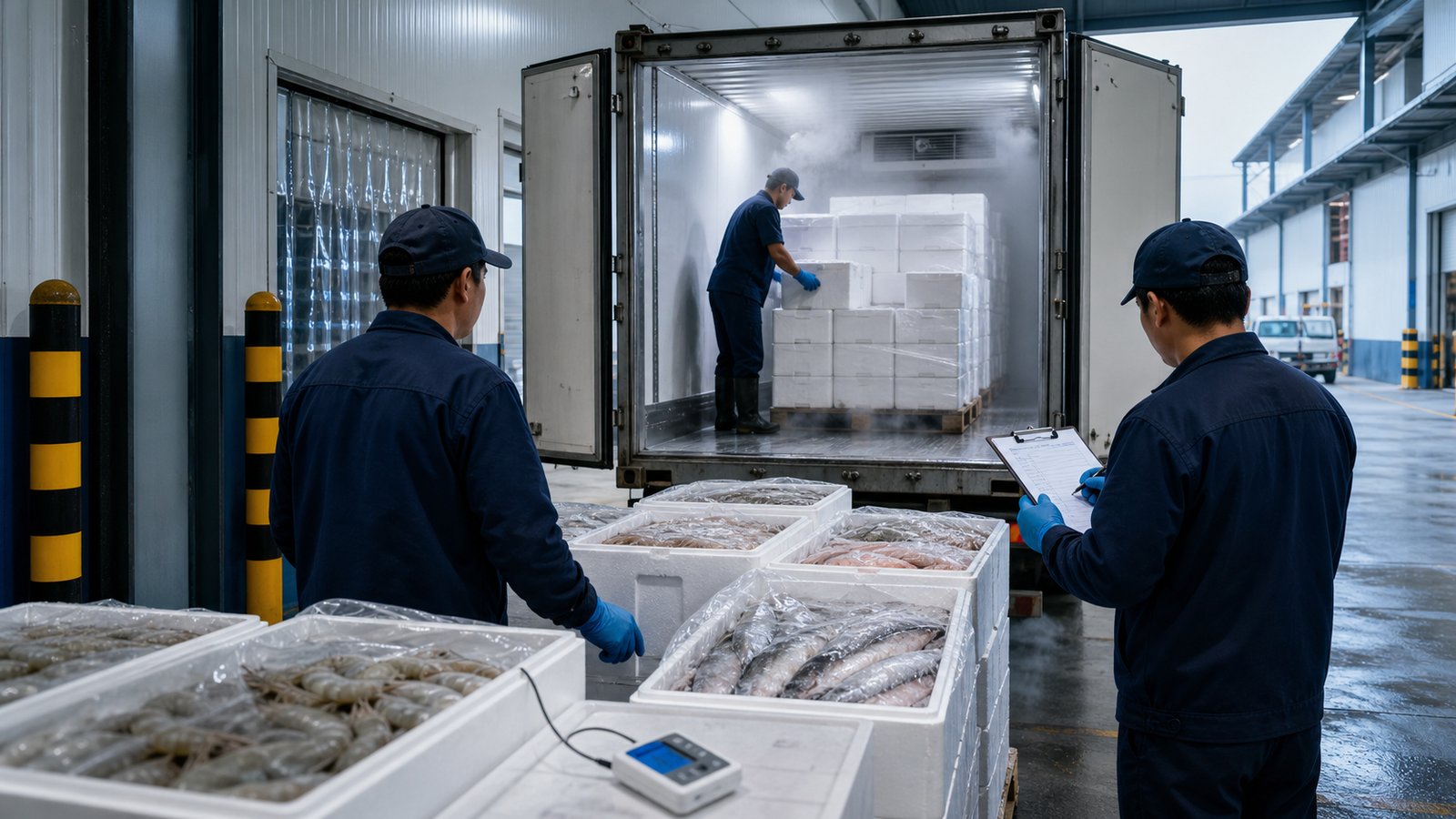
What is the cold-chain evidence standard? The exporter needs freezer records, packing records, reefer pre-trip inspection, set point, logger data, plug-in history, seal records, arrival inspection, survey photos, and buyer test results. Missing temperature data usually hurts the claim more than a weak narrative.
Commodity Profile: Shrimp, Prawn, and Fish
Malaysian seafood exports sit across aquaculture, wild-caught fish, and processed seafood. Perak has a shrimp and aquaculture profile, while Sabah and Sarawak are natural fish and marine-origin states. Use those origin labels with care in cargo documents because the buyer, FDA, Japan, or EU reviewer may read origin, processor, farm, and vessel records together.
The repeat exporter structure is usually marine cargo open cover. The industry context overlaps with food, beverage and halal exports cargo insurance, even where the product is not halal-sensitive, because the same cold-chain, contamination, and buyer-rejection evidence appears in F&B claims.
Blast-Frozen, IQF, and Carton Evidence
Blast-frozen seafood and individually quick frozen seafood are not the same cargo file. Blast-frozen cartons may fail through carton core temperature, pallet stacking, slow loading, or partial thaw. IQF products may fail through clumping, ice glaze breakdown, dehydration, odour, or contamination.
| Evidence point | Why it matters | Who usually holds it |
|---|---|---|
| Freezer and pack-out record | Shows product condition before the transit began | Processor, cold store |
| Reefer pre-trip inspection | Shows container equipment condition before loading | Carrier, depot, forwarder |
| Temperature logger and reefer download | Shows whether thaw or abuse occurred during the journey | Exporter, carrier, consignee |
| Seal and door record | Shows access, customs examination, and tampering points | Forwarder, carrier, customs broker |
| Buyer inspection and lab report | Shows the rejection reason at destination | Buyer, importer, regulator |
For exporters that need a wider documentary spine, pair the seafood file with marine cargo insurance for Malaysian exporters and phytosanitary certificate requirements for agricultural exports.
Regulatory Rejection Is Not Always Cargo Damage
A buyer or regulator can reject seafood for drug residue, pathogen finding, decomposition, histamine, indole, labelling, missing certificate, IUU documentation, or country-specific entry rules. Some of those issues may arise before transit. Some may arise during transit. Some may be pure compliance failures.
The cargo policy question is narrower: did insured physical loss or damage occur during the covered transit? If the shipment thawed because the reefer failed, the cargo file starts with physical condition. If the shipment was refused because the exporter could not produce an accepted certificate, the file starts as a compliance problem.
US, Japan, and EU Buyer Files
For the United States, FDA seafood HACCP rules and import alerts make processor history, product category, and detention evidence important. FDA import refusal guidance also states that a refused shipment must be destroyed or exported under CBP and FDA supervision within 90 days of the refusal notice, unless an extension applies.
For Japan, MHLW import food procedures mean the importer, notification form, quarantine station review, and inspection result should be retained with the insurance file. A Japanese buyer rejection without the MHLW or buyer test record is too thin for a serious claim discussion.
For the EU, the IUU catch certificate and CATCH file are separate from the cargo-damage file. They still matter because an IUU documentation failure can look commercially similar to a cargo loss even when the goods are physically sound.
Transit Duration and Reefer Planning
Do not build the insurance file around generic transit durations. Japan, US west coast, and EU destinations have different service patterns, transshipment points, and customs or inspection windows. The claim file should keep the booked sailing schedule, planned ETA, revised ETA, transshipment notices, and actual discharge record for each shipment.
The longer the lane, the more the exporter should care about power interruptions, transshipment dwell, door openings, temperature recorder battery life, and buyer inspection timing. A Japan air or sea shipment, a US west coast reefer, and an EU reefer via a hub do not produce the same evidence trail.
For annual or repeat flows, compare open cover vs single shipment. If seafood sits in cold storage before and after transit, compare the transit policy with stock throughput insurance Malaysia.
Coverage Response: Reefer Cargo, Rejection, and Survey
The starting point for frozen seafood exporters is normally ICC(A), IUA / LMA clause text, 2009 edition, because it is the broadest standard marine cargo clause for physical loss or damage. ICC(B) and ICC(C) are named-perils forms and may be too narrow for a chilled or frozen food claim where the event is discovered only after unpacking, testing, or buyer inspection.
That does not mean every rejected seafood shipment is paid. ICC(A) still excludes inherent vice, delay, ordinary loss in weight or volume, and insufficiency or unsuitability of packing where the issue is attributable to the assured before cover attaches. For seafood, those exclusions are not abstract words. They map directly to poor freezing before loading, a weak carton, missing gel or liner specification, wrong reefer set point, or product that was already non-compliant before shipment.
The policy and declaration should state frozen seafood accurately. Do not hide shrimp, prawn, fish fillets, squid, or mixed seafood under a broad "foodstuff" description if the underwriter expects a perishable-goods declaration. Where the exporter ships regularly, the open cover should name refrigerated or frozen cargo, temperature band, packing method, monitoring method, and any special destination markets such as the United States, Japan, EU, China, or Middle East.
Some insurers may offer deterioration or temperature-control extensions, mechanical breakdown wording, or rejection-related extensions for selected food cargo. Those extensions vary by insurer and are not a substitute for the core evidence trail. The exporter should ask three questions before binding: what temperature events are covered, what records must be produced, and whether regulatory rejection without physical damage is excluded.
Risk Categories Underwriters Actually Read
Frozen seafood is not a single risk. A carton of IQF shrimp, a reefer full of frozen fish, and an air-freighted high-value seafood consignment create different questions for an underwriter and claims surveyor.
Temperature excursion and thaw-refreeze evidence
A thaw-refreeze dispute usually begins at destination. The cartons may look intact, but the buyer reports clumping, drip loss, texture change, ice crystal formation, odour, or microbial concern. The claim file needs to show the temperature story across pack-out, loading, port dwell, ocean voyage or air movement, transshipment, discharge, and final cold-store entry.
Reefer data alone can be incomplete. The exporter should keep logger data inside the cargo, controller downloads from the container, plug-in records, set-point instructions, and terminal exception records. If the buyer uses only a handheld thermometer at arrival, the insurer may ask whether the reading reflects cargo core temperature, surface temperature, or post-arrival handling.
Contamination and food-safety findings
Contamination can be physical, chemical, biological, or odour-related. A leaking neighbouring cargo, unclean container, broken seafood packaging, cross-contact during inspection, or incorrect cold-store handling can all create a saleability issue. The exporter needs photos, survey notes, lab report, container inspection, and sample identity before the cargo is reworked, destroyed, or sold at a discount.
FDA, Japan, and EU files also create a sequencing problem. If the lab issue was present before shipment, cargo insurance is not the repair tool. If the product was clean at loading and a transit event created contamination, the claim has a physical-damage route to discuss.
Regulatory hold and disposal pressure
FDA refusal rules, Japan quarantine station review, and EU IUU checks can push exporters into fast decisions. Goods may need to be re-exported, destroyed, relabelled, held, or tested again. The claim mistake is agreeing to disposal before the surveyor sees the cargo and before the exact hold reason is documented.
A hold notice is evidence, but it is not proof of insured damage. Keep the official notice, buyer letter, lab result, photos, storage temperatures during hold, and any instruction from the insurer. If the cargo deteriorates while held, record when and why that deterioration happened.
Trade Documentation for Seafood Exports
The seafood export file should be built in layers. Finance needs invoice, packing list, insurance certificate, and transport document. Compliance needs health, origin, catch, farm, processor, HACCP, veterinary, or phytosanitary papers where applicable. The claim handler needs condition evidence.
| Shipment stage | Documents to retain | Claim question answered |
|---|---|---|
| Before packing | Processor approval, product specification, freezer log, batch record, lab result | Was the seafood sound before transit? |
| During loading | Pack-out photos, carton count, logger serial number, reefer PTI, set point, seal number | Was the unit packed and monitored correctly? |
| During transit | Booking, carrier notices, transshipment record, plug-in history, reefer download | Where could a temperature event have occurred? |
| At destination | Arrival temperature, survey report, buyer inspection, lab report, regulator notice | What was the actual condition at discovery? |
| After rejection | Mitigation instructions, salvage sale, destruction certificate, re-export file | Was the loss handled and valued properly? |
This documentation layer is also useful for MQL qualification. A seafood exporter asking for a quote should be able to provide annual shipment count, product categories, highest container value, destination markets, temperature band, claims history, and whether the cargo is shipped under FOB, CIF, CIP, FCA, or DAP terms.
Common Claim Scenarios for Frozen Seafood
Scenario 1: Japan buyer rejects IQF shrimp for clumping
The shipment arrives with cartons intact, but the buyer reports that IQF shrimp have clumped and lost free-flowing condition. The exporter needs the in-carton logger, reefer download, loading photos, buyer photos, and a technical statement linking clumping to a temperature event rather than normal handling or pre-shipment moisture.
The claim succeeds or fails on causation. If the reefer record shows a sustained temperature deviation during transshipment and the pack-out record shows good condition at origin, the file is stronger. If the only evidence is a buyer complaint two weeks after delivery, the file is weak.
Scenario 2: FDA detention after seafood arrives in the United States
The importer receives a detention or refusal linked to decomposition, histamine, HACCP, contamination, or an import alert. The exporter should not treat the notice as an automatic insured loss. First, identify whether the issue is regulatory status, pre-existing product condition, or transit damage.
If the cargo has to be destroyed or re-exported, keep the FDA notice, CBP records, storage temperature during the hold, survey report, and cost records. If the cargo remained physically sound but failed regulatory entry due to documentation or pre-existing residue, the loss is commercial or compliance-led.
Scenario 3: EU buyer blocks release over catch documentation
The seafood is physically frozen and saleable, but the EU buyer or competent authority questions the catch certificate, vessel data, or CATCH submission. That is an IUU compliance problem first. Cargo insurance does not replace the EU catch certification file.
If the hold later causes physical deterioration because storage is mishandled, the exporter needs a second evidence file showing when the deterioration occurred, who controlled the cargo, and whether the policy still covered that period.
Scenario 4: Shortage after cold-store consolidation
Frozen cartons can go missing at cold-store consolidation, customs examination, or destination distribution. The file needs count sheets, seal records, warehouse receipts, photos, and exception notes. Without a clean tally from each handoff, the shortage can become an argument between processor, forwarder, cold store, carrier, and buyer.
Decision Matrix: Cargo Claim, Compliance Issue, or Sale Dispute?
Frozen seafood losses are messy because the same shipment can involve buyer rejection, regulator action, temperature data, and food-safety tests. The table below helps the exporter sort the issue before notifying the wrong party or giving the buyer a discount too early.
| Situation | Likely first file | Evidence to collect |
|---|---|---|
| Reefer download shows a sustained temperature deviation | Cargo insurance claim | Logger, reefer data, plug-in record, survey, product assessment |
| FDA or Japan hold is based only on missing or mismatched documents | Compliance and buyer file | Official notice, certificate, importer correspondence, corrected documents |
| Buyer says seafood is off specification but temperature record is clean | Sale contract and quality file | COA, retained samples, buyer test, packing record |
| Cartons are wet, crushed, contaminated, or thawed on arrival | Cargo insurance claim | Photos before movement, survey, seal, delivery exception, temperature record |
| EU buyer questions IUU catch certificate but cargo is physically sound | Trade compliance file | Catch certificate, CATCH record, vessel or farm origin documents |
First 24 Hours After a Seafood Rejection
The first day matters because seafood evidence disappears quickly. The exporter should stop disposal, rework, sale, or repacking until the insurer or surveyor gives instructions. If the buyer must move the cargo for food-safety reasons, ask for photos, temperatures, and written reason before movement.
Notify the insurer, forwarder, carrier, cold store, and buyer in writing. Ask for the reefer download immediately because controller data can be harder to retrieve after the container is returned. Preserve the logger, seal, cartons, pallet, labels, and samples.
Ask the buyer to separate the cargo into affected and unaffected lots. A full shipment rejection may later become a partial loss if only some pallets or cartons show damage. Sorting without survey can reduce the claim value, but refusing to mitigate can also create problems. The right step is documented mitigation, not panic movement.
Programme Design for Seafood Exporters
A frozen seafood exporter with repeat shipments should not buy cover one container at a time unless the trade is genuinely occasional. An open cover allows the exporter to pre-agree cargo descriptions, temperature expectations, destination markets, and claim notification steps before a buyer rejection happens.
| Programme setting | Recommended treatment |
|---|---|
| Cargo description | Name frozen shrimp, prawn, fish, squid, or processed seafood instead of using a generic food label |
| Temperature evidence | Require logger or reefer data for high-value or long-haul markets |
| Destination markets | List the United States, Japan, EU, China, or other buyer markets with different inspection demands |
| Maximum shipment value | Set limits around peak reefer value, not average shipment value |
| Claims protocol | Pre-agree survey, sample preservation, disposal approval, and buyer notice steps |
This is also where lead quality improves. A seafood exporter who can provide destination markets, annual containers, temperature band, buyer rejection history, and highest reefer value is ready for a serious quote conversation. A vague request for "seafood insurance" is not.
Request the seafood cold chain reject documentation pack.
Send Voyage your product, origin state, temperature range, destination market, and buyer rejection wording. We will map the cargo, regulatory, and survey evidence needed before the next shipment leaves the freezer.
WhatsApp Kevin at +60 14 925 5243 or request a callback.
Frequently Asked Questions
Does frozen seafood cargo insurance cover FDA rejection?
Not by itself. FDA rejection must be tied to insured physical loss or damage during the covered transit before a standard cargo claim has a strong basis.
What evidence matters most for a temperature claim?
Freezer records, reefer set point, pre-trip inspection, logger data, plug-in history, arrival temperature, and buyer inspection records are the core evidence set.
Is IQF seafood treated differently from blast-frozen seafood?
The cargo policy may be the same, but the claim evidence differs. IQF claims often focus on clumping, glaze, dehydration, and thaw history, while blast-frozen carton claims focus on core temperature and pallet handling.
Does EU IUU failure trigger cargo insurance?
Usually no. IUU documentation failure is a trade-compliance issue unless it is tied to covered physical loss or damage to the seafood.
Should seafood exporters use open cover?
Repeat exporters usually should consider open cover because declarations, destination markets, peak container values, and claim steps can be set before each shipment.
What is the first action after buyer rejection?
Stop disposal or rework, appoint a surveyor, preserve the cold-chain record, collect the buyer rejection letter, and keep samples where lawful and practical.
Insuring Frozen Seafood Exports with Voyage
Frozen seafood claims depend on cold-chain proof, inspection records, and the difference between damaged cargo and rejected paperwork. Voyage can help Malaysian seafood exporters place marine cargo open cover that matches shrimp, prawn, fish, reefer, and buyer-inspection evidence.
Get a tailored quote. WhatsApp Kevin at +60 14 925 5243 or request a callback. Quotes turn around in 24-48 hours where the underlying cover is in place.
Disclaimer: This article provides general guidance on frozen seafood cargo insurance Malaysia as of May 2026. Coverage terms, conditions, and availability vary by insurer, policy, and jurisdiction. Always review your specific policy wording and consult a qualified insurance professional before making coverage decisions.
Why Voyage
Marine Insurance Specialists
International Underwriter Access
Both Sides of the Supply Chain
Malaysia and Singapore Expertise
Other industries
Explore other industries we cover


Get Best Rates / Quotation

Voyage is a specialist marine insurance intermediary arranging marine cargo and marine liability coverage for businesses in Malaysia, Singapore, and internationally. All insurance is placed through licensed broking partners.
Riskflow Sdn Bhd (202101001225):
Suite 3.19 (North Block), The Ampwalk, 218 Jalan Ampang, 50450 Kuala Lumpur, Wilayah Persekutuan Kuala Lumpur
t: +60149255243 (Kevin H.)
email: kevin@voyagecover.com