Cocoa Cargo Insurance Malaysia
Cocoa cargo insurance Malaysia for processors handling beans, grindings, cocoa butter, powder, and chocolate products. Temperature, MRLs, and claims.
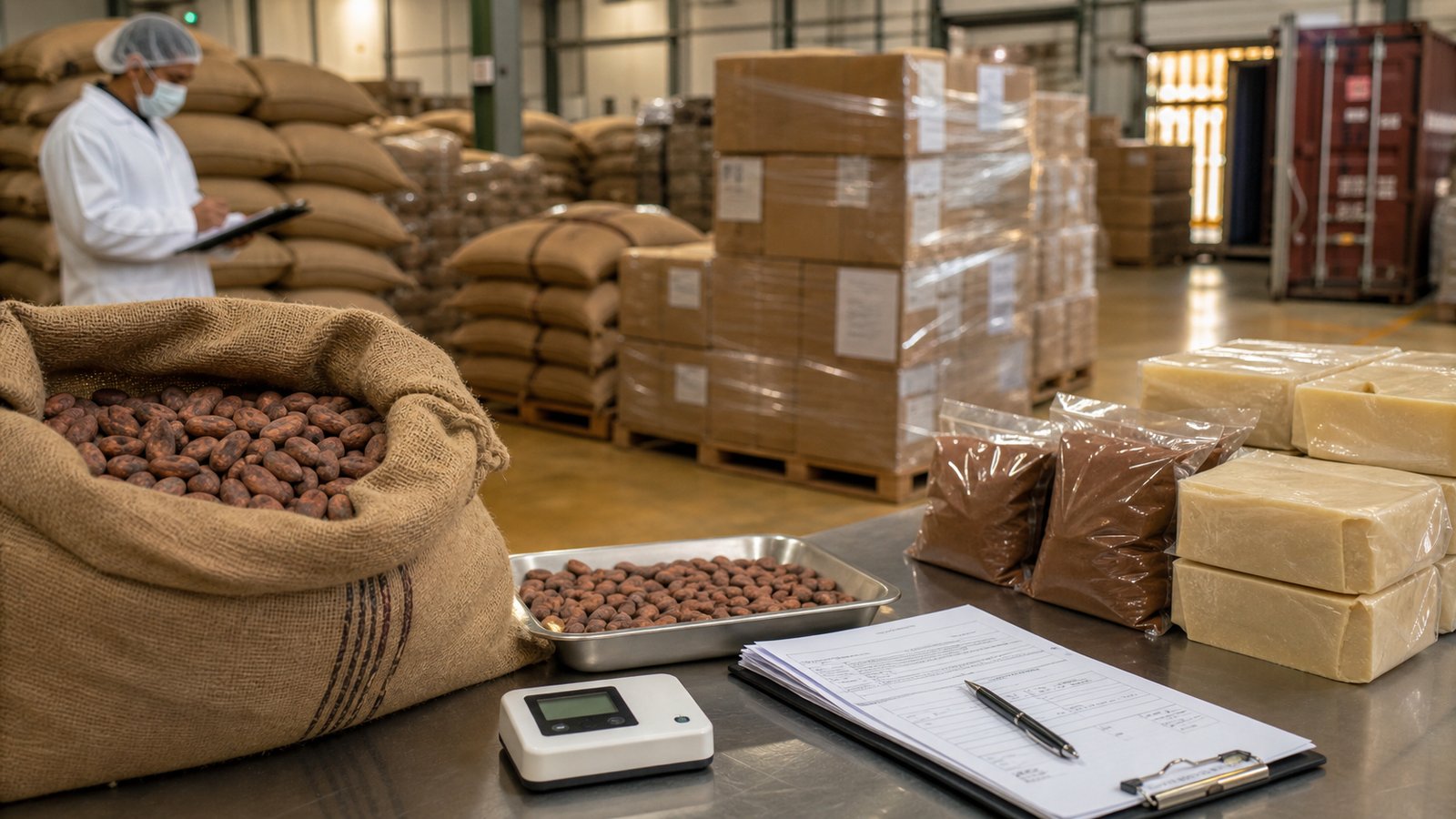
Cocoa Cargo Insurance Malaysia
Malaysia's cocoa industry is processor-led. Malaysian Cocoa Board statistics track grindings and cocoa product trade codes such as cocoa butter, cocoa powder, cocoa paste, and chocolate preparations, while 2024 reporting from the Malaysian Cocoa Board put cocoa export value at RM15.06 billion.
That matters for insurance because cocoa beans, grindings, cocoa butter, cocoa powder, and finished cocoa products do not fail the same way. A bean problem can become a processing problem, and a processing problem can look like a cargo claim if the file is not separated.
The Bean-to-Product Claim Question
Before shipment, decide whether the insured subject is raw beans, semi-processed product, finished product, or stock between processing stages.
Key Facts: Cocoa Cargo Cover for Malaysian Processors
What is cocoa cargo insurance Malaysia? It is marine cargo cover for cocoa beans, cocoa liquor, grindings, butter, powder, cake, chocolate ingredients, and finished cocoa products imported, exported, or moved between processing locations.
What is different about processors? Malaysian processors may import beans, transform them into semi-finished or finished products, then export higher-value cocoa goods. The insured value and claim evidence should change as the goods move from bean to product.
What is the main temperature issue? Cocoa butter and some finished cocoa products are heat-sensitive. Cargo guidance for cocoa butter warns that container air temperature can exceed ambient temperature and that melting incidents can create serious loss and cleanup problems.
What EU regulation affects pesticide checks? EU Regulation (EC) No 396/2005 sets maximum residue levels for pesticides in or on food and feed of plant and animal origin. Cocoa beans and cocoa products may be checked against MRLs depending on the market and product.
What evidence does a processor need? Origin lot, certificate of analysis, pesticide or residue test where required, fumigation or treatment record, processing batch, packing record, temperature record, container inspection, and retained samples should be traceable.
Commodity Profile: Beans, Butter, Powder, Finished Goods
Cocoa processors operate across different cargo states. Beans are agricultural cargo, usually shipped in bags or bulk. Cocoa butter and liquor are fat-based products with temperature and contamination sensitivity. Cocoa powder and cake are dry products that can fail through moisture, caking, odour, and packaging damage. Finished chocolate products add packaging, heat, bloom, and buyer specification risk.
Repeat processors normally start with marine cargo open cover. The industry overlap is food, beverage and halal exports cargo insurance and, for trading flows, commodity trading insurance Malaysia and Singapore.
Risk Profile by Cocoa Form
| Cocoa form | Transit risk | Claim evidence |
|---|---|---|
| Beans | Moisture, mould, infestation, pesticide or residue dispute, bag damage | Origin lot, moisture record, COA, treatment record, samples |
| Cocoa liquor or mass | Heat exposure, contamination, packing damage | Temperature log, packing record, seal, sample |
| Cocoa butter | Melting, leakage, contamination, temperature cycling | Temperature record, container inspection, packing photos, survey |
| Cocoa powder or cake | Moisture, caking, odour uptake, torn bags | Moisture test, packaging photos, container inspection |
| Finished cocoa goods | Heat damage, bloom, crushing, label or buyer specification dispute | Pack-out photos, temperature log, buyer inspection |
Where plant-health or agricultural documentation applies, compare phytosanitary certificate requirements.
Africa-Origin Beans and Malaysia Processing
When imported beans from Africa or other origins enter Malaysian processing, the claim file has two layers. The first is origin and import condition. The second is Malaysian processing and onward export condition. A contamination found after processing may have started in origin, storage, processing, or transit.
Keep origin lot numbers, supplier documents, arrival inspection, sampling, fumigation or pest treatment records, processing batch numbers, and finished product COAs. If those records are not linked, a cargo claim can become a causation argument.
For value changes after processing, pair the file with customs valuation and cargo insured value. If beans and finished products sit in warehouse before sale, compare stock throughput insurance Malaysia.
EU MRL and Buyer Rejection Issues
EU MRL rules are not cargo insurance rules. They are food safety and market-access rules. If cocoa product is rejected for pesticide residue that existed before transit, cargo insurance is unlikely to repair the sale.
If the cargo was contaminated during transit, the insurance discussion changes. The processor needs test results from before shipment, retained samples, container condition, incident evidence, and destination testing to show what changed and when.
Coverage Response: Beans, Semi-Processed Cargo, and Finished Goods
Cocoa cargo insurance should follow the stage of the goods. ICC(A), IUA / LMA clause text, 2009 edition, is the broad physical loss or damage starting point, but the evidence for a bean claim is not the evidence for a cocoa butter claim. Beans ask moisture, infestation, origin, and residue questions. Cocoa butter asks heat, melting, leakage, and contamination questions. Finished goods ask packaging, temperature, crushing, and buyer specification questions.
The policy declaration should identify the cocoa form, not only the generic commodity. "Cocoa products" is too broad if the exporter ships beans one month, butter the next, and finished chocolate preparations after that. Values change after processing, and underinsurance can appear if declarations lag behind the actual product stage.
Processors also need to think about storage. Imported beans may sit before grinding. Cocoa butter may sit in warehouse before export. Powder may be stored for buyer release. If the policy is transit-only, the loss may fall outside cover after marine transit ends. Stock throughput can be relevant where the business holds meaningful inventory across import, processing, and export.
Regulatory rejection is not automatically covered. EU MRL findings, buyer pesticide concerns, and origin residue disputes should be separated from physical transit loss. The processor's defence is a traceable chain from origin lot to arrival sample to processed batch.
Risk Categories for Cocoa Processors
Heat damage to cocoa butter and finished products
Cocoa butter and finished cocoa goods can suffer from heat exposure inside containers, terminals, or destination warehouses. The visible result may be melting, deformation, leakage, fat bloom, packaging staining, or buyer rejection. The claim needs temperature records, container stowage information where available, packaging photos, and arrival survey.
If the cargo is shipped through hot corridors, the exporter should consider insulated packing, temperature loggers, stowage instructions, and route timing. These controls do not create automatic cover, but they give the underwriter and claims handler a better file.
Moisture, mould, and caking in beans and powder
Beans and powder are vulnerable to moisture. Water ingress, container sweat, wet bags, or damp storage can lead to mould, caking, odour, and quality loss. The processor should retain moisture readings, container inspection, bag or liner photos, desiccant records, and destination survey.
Where the buyer reports mould after goods have been stored for weeks after delivery, the question becomes timing. Was the cargo wet on arrival, or did the damage occur in the buyer's warehouse?
Residue and contamination through the processing chain
Cocoa processors face a causation problem. A contamination finding may come from origin beans, fumigation, processing equipment, storage, packaging, container, or transit. The insurance file should not start at export only if the product originated as imported beans.
Link supplier lots, incoming inspection, processing batch, retained samples, COA, packing record, and shipment documents. If the chain breaks, the insurer may not be able to identify a covered transit event.
Documentation Pack for Cocoa Cargo
A processor's documentation pack should be built by product stage. The file has to support both insurance and buyer-quality arguments, because a cocoa claim often sits between cargo damage and quality control.
| Stage | Documents | Claim question |
|---|---|---|
| Bean import | Origin lot, phytosanitary or import papers where applicable, moisture, treatment, arrival inspection | Were beans sound before processing? |
| Processing | Batch record, COA, retained sample, cleaning record | Did the issue arise before export transit? |
| Packing | Bag, carton, liner, pallet, temperature-control record | Was packing suitable for the product? |
| Transit | Container inspection, seal, logger, booking, carrier notices | Did the physical event happen while covered? |
| Destination | Survey, buyer test, photos, rejection letter, salvage record | What condition and value loss were documented? |
For quote intake, Voyage should ask whether the client imports beans, exports cocoa butter or powder, holds stock, uses temperature-controlled logistics, ships to the EU, and has prior MRL, moisture, or heat claims.
Common Claim Scenarios
Scenario 1: Cocoa butter melts in a dry container
The buyer reports cartons stained by melted product after a hot voyage. The exporter needs packing photos, container details, temperature logger where used, arrival survey, and buyer photos. If no logger was used, the claim may still proceed, but causation becomes harder.
Scenario 2: Cocoa powder arrives caked and damp
The surveyor should inspect container roof, walls, floor, bag location, desiccant, and moisture readings. If the outer bags are affected first, the pattern may suggest water ingress or condensation. If every bag is affected uniformly, pre-shipment moisture or storage may be questioned.
Scenario 3: EU buyer rejects product for pesticide residue
The processor needs origin lot records, pre-shipment testing, retained samples, and destination lab method. If the residue was present before transit, cargo insurance is not the answer. If contamination happened during transit, the file needs proof of that event.
Scenario 4: Finished cocoa goods crushed in consolidation
Crushed cartons, broken retail packs, and pallet collapse require photos before unpacking, container loading plan, pallet specification, survey, and destination tally. If the cargo was packed inadequately before loading, the packing exclusion may be raised.
Buyer Market Differences for Cocoa Cargo
Cocoa cargo buyers do not all reject cargo for the same reason. An EU buyer may focus on pesticide MRLs and food-safety testing. A Middle East buyer may focus on heat exposure and packaging condition. A manufacturer may focus on colour, fat content, odour, particle size, moisture, or foreign matter. The cargo insurance file should be able to answer physical-condition questions alongside buyer specification questions.
For EU cargo, keep residue testing and origin evidence separate from the transit damage file. For hot-corridor cargo, use temperature loggers where the value supports it. For finished goods, keep pack-out photos and palletisation details because a crushed carton claim often becomes a packing argument.
If cocoa is sold under LC terms, the insurance certificate should match the goods description, insured value, Incoterms basis, voyage, and buyer wording. A certificate that describes "food products" may not be enough when the LC names cocoa butter, cocoa powder, or chocolate preparations.
What to Send Before Requesting a Cocoa Quote
| Quote field | Why it matters |
|---|---|
| Cocoa form | Beans, butter, liquor, powder, and finished goods have different loss patterns |
| Origin and processing stage | Shows whether the risk begins at bean import, factory output, or export warehouse |
| Temperature sensitivity | Identifies whether heat exposure and logger evidence matter |
| Destination market | Shows whether MRL, food-safety, or buyer specification files are likely |
| Storage before and after transit | Helps decide whether transit-only or stock throughput should be reviewed |
A processor with imports and exports should send both directions of the flow. The underwriter needs to see whether the same policy is expected to cover beans arriving in Malaysia, stock in storage, semi-processed product, and finished exports.
Binding Decisions Before Cocoa Cargo Moves
The first decision is whether the cover follows only the export leg or the full processor flow. A Malaysian cocoa processor may import beans, store them, process them, hold semi-finished goods, then export butter, powder, or finished goods. If only the final export leg is insured, losses during earlier storage or internal transfer may sit outside the cargo policy.
The second decision is temperature control. Cocoa butter and finished goods may need logger evidence, shaded loading, insulated packing, or route timing. If the exporter chooses ordinary dry container movement for heat-sensitive product, the underwriter may later ask whether packing and route were suitable.
The third decision is residue and MRL evidence. If the buyer market is sensitive to pesticide or contaminant findings, pre-shipment testing and retained samples should be kept in the same file as the cargo documents. That does not make regulatory rejection insured, but it helps separate origin quality from transit damage.
Decision Matrix: Transit Damage, Processing Defect, or Buyer Rejection?
Cocoa processors need to classify the loss by product stage. The same buyer complaint can point to origin beans, processing, packing, transit, or destination storage.
| Situation | Likely first file | Evidence to collect |
|---|---|---|
| Cocoa butter arrives melted or leaking | Cargo insurance claim | Temperature record, photos, packing record, survey, buyer report |
| EU buyer reports pesticide residue | Compliance and origin-quality file | Origin lot, pre-shipment test, retained sample, buyer lab method |
| Cocoa powder arrives caked in outer bags | Moisture and cargo causation file | Container inspection, bag position, moisture readings, survey |
| Finished chocolate cartons are crushed | Handling damage claim | Loading photos, pallet spec, delivery exception, survey |
| Buyer says product is outside factory specification | Processing and sale-contract file | Batch record, COA, retained sample, buyer test |
First 24 Hours After a Cocoa Cargo Complaint
Identify the product stage first. Beans, butter, powder, and finished goods need different survey and sampling. Ask the buyer for photos before movement and preserve affected and unaffected samples.
If heat damage is alleged, secure any temperature logger and collect terminal, container, and warehouse timing. If moisture is alleged, inspect the container or carrying unit before it is returned. If residue is alleged, preserve pre-shipment and destination lab reports with sample identity.
Do not blend, melt, reprocess, roast, or repack the affected cargo before survey unless mitigation requires it and the insurer has been notified. Processing the cargo can destroy the evidence needed to separate transit damage from product defect.
Programme Design for Cocoa Processors
Cocoa processors need a programme that follows transformation of value. A bean shipment, cocoa butter shipment, powder shipment, and finished product shipment can all sit inside one client account, but the claim evidence and insured value are different.
| Programme setting | Recommended treatment |
|---|---|
| Product stage | Separate imported beans, semi-finished goods, cocoa butter, powder, and finished products |
| Storage exposure | Review whether stock before and after transit needs stock throughput treatment |
| Heat controls | Use logger, route, packing, and shaded handling rules for heat-sensitive cargo |
| MRL and residue file | Keep origin lot, test, retained sample, and buyer lab evidence separate from cargo damage |
| Value declaration | Update declarations when beans become higher-value processed products |
Voyage can qualify a cocoa processor lead fastest when the processor sends product stages, annual import and export values, storage locations, buyer markets, and prior heat, moisture, or MRL issues. That turns the conversation from commodity label to actual programme design.
Request the cocoa product cargo documentation pack.
Send Voyage your cocoa form, origin, processing stage, shipment value, and buyer market. We will map the bean-to-product documents that support temperature, contamination, MRL, and cargo condition claims.
WhatsApp Kevin at +60 14 925 5243 or request a callback.
Frequently Asked Questions
Does cocoa cargo insurance cover EU pesticide rejection?
Not by itself. If residue existed before transit, the issue is compliance or supplier quality. A cargo claim needs insured physical loss or damage during transit.
Is cocoa butter temperature-sensitive cargo?
Yes. Cocoa butter can be damaged by heat exposure, melting, leakage, and temperature cycling, so temperature and container evidence matter.
What value should a cocoa processor insure?
Use the value at risk for the cargo stage: beans, semi-finished product, or finished goods, plus any contract uplift required by sale terms or LC terms.
Does cargo insurance cover processing defects?
Usually no. Processing defects must be separated from transit damage through batch records, samples, and pre-shipment inspection.
Should processors use stock throughput cover?
Consider it if cocoa is held in warehouses between import, processing, and export. Transit-only cover may not cover storage risk.
What is the first action after a cocoa butter melt claim?
Preserve the container, take photos, keep temperature records, appoint a surveyor, retain samples, and avoid disposal before the claim file is documented.
Insuring Cocoa Cargo with Voyage
Cocoa processors need cover that follows the cargo stage, not a single generic commodity label. Voyage can help Malaysian processors place marine cargo open cover around beans, grindings, cocoa butter, powder, finished goods, stock, temperature, MRL, and contamination evidence.
Get a tailored quote. WhatsApp Kevin at +60 14 925 5243 or request a callback. Quotes turn around in 24-48 hours where the underlying cover is in place.
Disclaimer: This article provides general guidance on cocoa cargo insurance Malaysia for processors as of May 2026. Coverage terms, conditions, and availability vary by insurer, policy, and jurisdiction. Always review your specific policy wording and consult a qualified insurance professional before making coverage decisions.
Why Voyage
Marine Insurance Specialists
International Underwriter Access
Both Sides of the Supply Chain
Malaysia and Singapore Expertise
Other industries
Explore other industries we cover


Get Best Rates / Quotation

Voyage is a specialist marine insurance intermediary arranging marine cargo and marine liability coverage for businesses in Malaysia, Singapore, and internationally. All insurance is placed through licensed broking partners.
Riskflow Sdn Bhd (202101001225):
Suite 3.19 (North Block), The Ampwalk, 218 Jalan Ampang, 50450 Kuala Lumpur, Wilayah Persekutuan Kuala Lumpur
t: +60149255243 (Kevin H.)
email: kevin@voyagecover.com