MITI Export Licence and the Strategic Trade Act: Which Malaysian Exports Need a Permit
Over 1,500 items need MITI strategic trade permits to export from Malaysia. Which goods need a licence, how the STA 2010 works, and insurance impact.
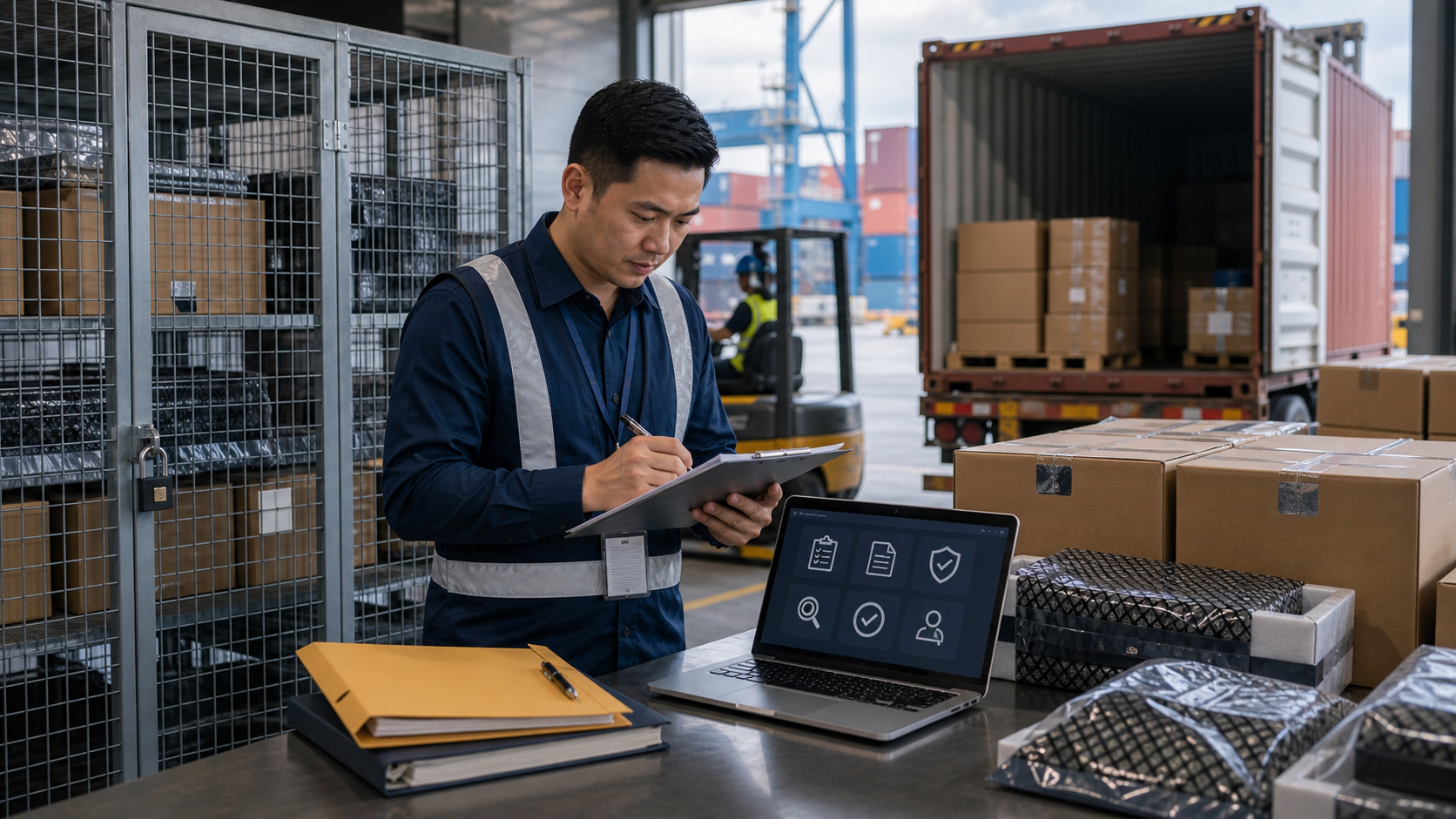
Over 1,500 items on Malaysia's Strategic Items Order require a MITI export permit before they can legally leave the country (Ministry of Investment, Trade and Industry, 2023). The list covers military goods, dual-use items, electronics, telecommunications equipment, sensors, chemicals, and nuclear materials. If your export falls on this list and you ship without the permit, Royal Malaysian Customs can seize the cargo, MITI can impose criminal penalties under the STA 2010, and your cargo insurer may decline any resulting claim on the grounds that the shipment was unlawful.
Most Malaysian exporters of consumer goods will never encounter the STA. But exporters of electronics and semiconductors, industrial chemicals, precision equipment, and any goods with potential dual-use applications need to understand where their products sit on the strategic items list.
Key Facts: MITI Export Licences and the STA 2010
What is the Strategic Trade Act 2010? The STA 2010 is a Malaysian law controlling the export, transhipment, transit, and brokering of strategic items. It was enacted to fulfil Malaysia's obligations under United Nations Security Council Resolution 1540, which requires member states to establish export control systems for weapons of mass destruction-related items.
What are strategic items? Strategic items are goods and technology controlled under the Strategic Trade (Strategic Items) Order 2010. They fall into two categories: military items (Category ML) and dual-use items (Categories 0-9), covering nuclear materials, electronics, computers, telecommunications, sensors, lasers, navigation, marine equipment, and aerospace components.
Who administers the STA 2010? The Strategic Trade Secretariat (STS) within the Ministry of Investment, Trade and Industry (MITI) administers the Act, with support from partner agencies: the Atomic Energy Licensing Board (AELB), Malaysian Communications and Multimedia Commission (MCMC), and the Pharmaceutical Services Division.
What happens if you export without the required permit? Penalties under the STA 2010 include fines, imprisonment, and cargo seizure. Royal Malaysian Customs, as an authorised officer under the Act, can inspect and detain strategic items prior to shipment. A K2 customs declaration field requires all exporters to declare whether items fall under the STA 2010.
The Strategic Items Classification System
The Strategic Trade (Strategic Items) Order 2010 organises controlled items into the following categories, reflecting the international export control regime structure:
| Category | Items Controlled | Malaysian Export Relevance |
|---|---|---|
| ML | Military items | Defence equipment, weapons systems |
| 0 | Nuclear materials, facilities, equipment | Nuclear fuel, reactor components |
| 1 | Special materials and related equipment | Certain alloys, composites, chemical precursors |
| 2 | Materials processing | CNC machines, industrial furnaces |
| 3 | Electronics | High-performance ICs, semiconductor equipment |
| 4 | Computers | High-performance computing systems |
| 5 | Telecommunications and information security | Encryption equipment, network security tools |
| 6 | Sensors and lasers | Optical sensors, laser systems |
| 7 | Navigation and avionics | GPS systems, inertial navigation |
| 8 | Marine | Underwater detection equipment, marine propulsion |
| 9 | Aerospace and propulsion | Aerospace components, unmanned aerial systems |
For Malaysian electronics exporters, Categories 3 (Electronics), 4 (Computers), and 5 (Telecommunications) are the most frequently encountered. A semiconductor fabrication company exporting high-performance integrated circuits, or a manufacturer exporting network security equipment with encryption capabilities, may find their products on the strategic items list even though the items are commercial products sold to civilian end-users.
The Export Process Under STA 2010
The STA export process involves three steps that integrate with the standard K2 customs export declaration.
Step 1: Classification. The exporter checks whether their product falls on the Strategic Items Order. MITI's Strategic Trade Secretariat provides classification guidance, and exporters can submit product specifications for evaluation. The classification is based on the item's technical specifications, not its intended use.
Step 2: Permit application. If the item is classified as strategic, the exporter applies for a MITI export permit through the ePERMIT STA system. The application requires details of the item, the end-user, the end-use, and the destination. Partner agencies (AELB for nuclear items, MCMC for telecommunications) may be involved in the review.
Step 3: K2 declaration and shipment. The K2 customs export form includes a mandatory field for STA declaration. The exporter must declare whether the item is a strategic item and reference the MITI permit number. Royal Malaysian Customs can inspect the goods against the declaration before allowing export. The forwarder handling the export documentation must include the MITI permit as part of the shipment file.
Where the Insurance Bridge Sits
Exporting strategic items without the required MITI permit creates insurance exposure at multiple points.
Cargo seizure. If Customs seizes the cargo for non-compliance with the STA 2010, the goods are detained and potentially confiscated. A cargo insurance policy may not cover the loss arising from an unlawful shipment. Under the duty of disclosure, the assured is expected to comply with applicable laws. Shipping controlled goods without the required permit is a breach that may void the policy.
Sanctions intersection. Some strategic items are also subject to international sanctions regimes. A shipment of dual-use electronics to a restricted end-user may trigger both the STA 2010 permit requirement and the sanctions clause in the cargo insurance policy. The sanctions clause suspends coverage independently of the STA issue.
Forwarder liability. A freight forwarder who ships goods without verifying whether a MITI permit is required faces potential liability under FMFF STC Clause 6.2 (customer liable for inaccurate information) and Clause 7.1 (forwarder liable for failure to exercise reasonable care). If the forwarder should have known the goods were strategic, the "due diligence" defence may not hold.
The practical insurance lesson: compliance with the STA 2010 is not just a regulatory obligation. It is a precondition for valid cargo insurance coverage. A shipment that is lawful and properly documented is insurable. A shipment that breaches export control law may not be.
The "Catch-All" Clause: Section 12 Unlisted Items
The STA 2010 includes a "catch-all" provision under Section 12 that extends control beyond the Strategic Items Order. The Strategic Trade Controller can issue directives requiring export permits for items not on the main list if there is reasonable cause to believe the items may be used for weapons of mass destruction or their delivery systems.
In practice, this means an item not on the Strategic Items Order can still require a permit if MITI issues a directive. The Strategic Trade Secretariat has issued and rescinded directives under Section 12; for example, Directive No. 2/2025 on nuclear- and missile-usable isocyanates was rescinded effective 7 May 2026 (MITI, 2026). Exporters of chemical intermediates and industrial precursors should monitor STS directives in addition to the main strategic items list.
Restricted and Prohibited End-Users
Beyond item classification, the STA 2010 controls exports based on the identity of the end-user. The Strategic Trade (Restricted End-Users and Prohibited End-Users) Orders 2010 and 2016 list persons and entities subject to export restrictions, reflecting United Nations Security Council sanctions.
Embargoed destinations include several countries subject to transit permit requirements for military items. Designated individuals and entities of North Korea (under UNSCR 1718) and Iran (under UNSCR 2231) are specifically listed.
End-user screening is a separate obligation from item classification. An item that is not on the Strategic Items Order can still require a permit if the end-user is restricted. Malaysian exporters of manufactured goods and commodity trading houses dealing with international buyers should incorporate end-user screening into their compliance process.
Internal Compliance Programmes
MITI encourages Malaysian companies handling strategic items to establish Internal Compliance Programmes (ICPs). An ICP is a company-level compliance framework covering item classification, end-user screening, record-keeping, and staff training.
Companies with an established ICP may benefit from streamlined permit processing. MITI has introduced three ICP elements since the STA's implementation: standard compliance documentation, intangible technology transfer controls, and regular audit procedures. All ICP-status companies and new applicants must adhere to the revised ICP checklist.
From an insurance perspective, a documented ICP demonstrates good faith compliance with export control obligations. In the event of an inadvertent STA breach, an exporter with an ICP is better positioned to argue that the breach was unintentional and that they exercised due diligence.
Frequently Asked Questions
Do I need a MITI export licence to export electronics from Malaysia?
It depends on the technical specifications. Items in Categories 3, 4, and 5 of the Strategic Items Order may require a permit. Standard consumer electronics generally do not. Check the Strategic Items Order or submit to STS for classification.
What happens if I export a strategic item without a MITI permit?
Customs seizure, criminal penalties under the STA 2010, and potential voiding of cargo insurance coverage for the unlawful shipment.
Does the STA 2010 control imports as well as exports?
No. The STA 2010 controls export, transhipment, transit, and brokering. Importation is governed by the Customs Act 1967 and other relevant laws.
How does the STA 2010 interact with IMDG Code requirements?
Some controlled items are also dangerous goods under the IMDG Code. Both requirements apply separately and cumulatively.
Can my freight forwarder handle the MITI permit application?
The permit is issued in the exporter's name. The forwarder may assist with documentation but the exporter holds responsibility for obtaining the permit.
How long are STA 2010 export records required to be kept?
At least six years, per Regulation 30 of the Strategic Trade Regulations.
Compliance-Ready Cargo Cover from Voyage
Voyage is a specialist marine insurance intermediary arranging marine cargo insurance for Malaysian exporters. Cargo insurance is part of the export compliance stack: a properly documented, lawfully exported shipment is insurable. Voyage works with underwriters experienced in Malaysian trade corridors to structure cover that responds when the compliance framework is met.
Get a tailored quote. WhatsApp Kevin at +60 19 990 2450 or request a callback. Quotes turn around in 24-48 hours where the underlying cover is in place.
Disclaimer: This article provides general guidance on MITI export licences and the Strategic Trade Act 2010 as of June 2026. Regulatory requirements, strategic items lists, and directives change periodically. Always verify current requirements with the Strategic Trade Secretariat and consult a qualified professional before making export decisions.
Why Voyage
Marine Insurance Specialists
International Underwriter Access
Both Sides of the Supply Chain
Malaysia and Singapore Expertise
Other industries
Explore other industries we cover


Get Best Rates / Quotation

Voyage is a specialist marine insurance intermediary arranging marine cargo and marine liability coverage for businesses in Malaysia, Singapore, and internationally. All insurance is placed through licensed broking partners.
Riskflow Sdn Bhd (202101001225):
Suite 3.19 (North Block), The Ampwalk, 218 Jalan Ampang, 50450 Kuala Lumpur, Wilayah Persekutuan Kuala Lumpur
t: +60149255243 (Kevin H.)
email: kevin@voyagecover.com