Semiconductor and E&E Cargo Insurance Malaysia
Penang chip exporters lose claims when declared value is set too low. See how to cover ESD, moisture damage, and high-value transit theft properly.
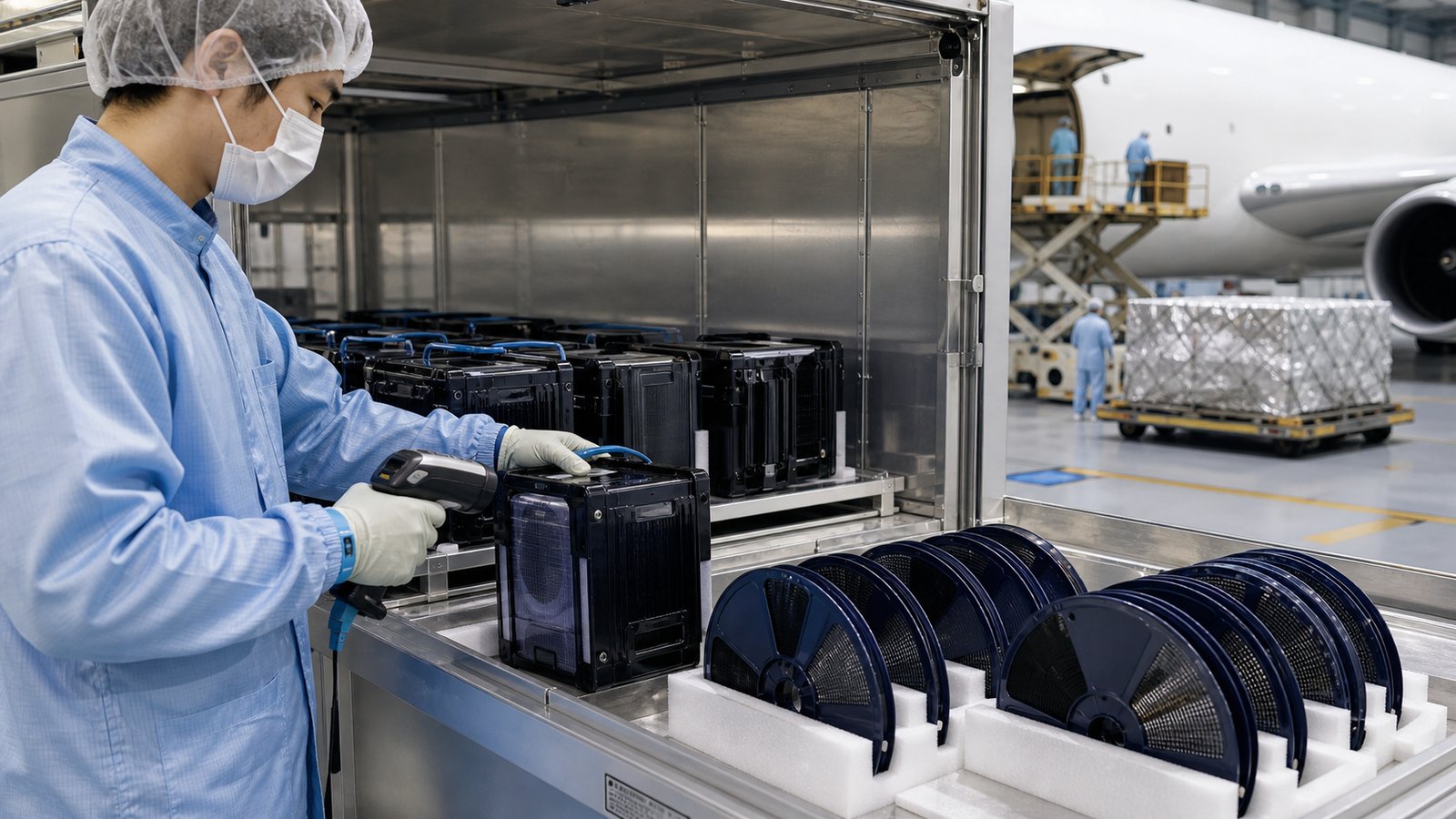
Malaysia exported a record RM601.21 billion of electrical and electronics goods in 2024, of which semiconductors alone accounted for RM437.5 billion (MATRADE / MIDA, 2024). The country is the sixth-largest semiconductor exporter in the world and handles close to 13 percent of global chip assembly, testing, and packaging.
That scale hides a quiet problem. A single reel of advanced packaging substrate, a tray of processors, or a wafer lot can carry more value per kilogram than almost anything else moving out of Penang or Kulim, yet it is routinely insured on the same generic open cover an exporter uses for crates of finished appliances. When a claim lands, the gap between declared value and true replacement cost is where the money is lost.
The Value Density Problem
Semiconductor and E&E cargo breaks the normal relationship between weight, volume, and value. A consignment that fits on a single pallet can be worth more than a full container of consumer goods. Cover, declared value, and security all have to be set against that value density, not against the size of the shipment.
Key Facts: Malaysian Semiconductor and E&E Cover
What is semiconductor cargo insurance Malaysia? It is marine and air cargo cover for wafers, integrated circuits, substrates, assembled chips, and finished E&E products moving from Malaysian fabs and assembly plants to overseas customers. The policy should match the product, the declared value basis, the handling sensitivity, and the route.
What clause form do exporters usually start from? Most high-value E&E cargo is placed on ICC (A), the broadest standard marine cargo form covering all risks of physical loss or damage except stated exclusions (IUA / LMA clause text, 2009 edition). Air movements use the equivalent Institute air cargo wording.
What decides whether the claim is paid in full? The declared or insured value. If cargo is insured on cost price or an outdated standard cost while the replacement chip now trades at a higher market level, the settlement can fall short of what the exporter must spend to make the customer whole.
What damage types matter most? Electrostatic discharge, moisture ingress, mechanical shock, and targeted theft. These are the failure modes underwriters and surveyors read first, and they map directly to packing, handling, and security evidence.
What about Incoterms? Electronics trades commonly on FCA, FOB, CIF, CIP, and DAP. Under Incoterms 2020 (ICC Paris), CIP now requires ICC (A) minimum cover, while CIF requires only ICC (C) minimum, so the term written on the contract changes who must arrange what level of cover.
Commodity Profile: From Bayan Lepas to the Customer
Malaysian E&E output is concentrated in a few corridors. Penang, anchored by Bayan Lepas, is the historic assembly and test hub; Kulim in Kedah extends it northward; the Klang Valley and Melaka add front-end and back-end capacity. Cargo leaves these clusters as wafers, bare die, substrates, reels, trays, modules, and finished devices, much of it by air for speed and security, the rest containerised for finished goods.
The repeat exporter structure for this flow is normally marine cargo open cover, with high-value consignments often better served by specialist and high-value transit insurance. The industry context sits under electronics and semiconductor cargo insurance Malaysia, which is where exporters in this sector should start before drilling into a specific shipment.
Transit Risks Specific to Chips and E&E
Generic cargo content treats electronics as just another fragile good. The real risk profile is narrower and more technical.
| Risk | How it shows up | Evidence that supports the claim |
|---|---|---|
| Electrostatic discharge | Latent device failure found only at incoming inspection or final test | ESD packaging spec, humidity-controlled bags, failure analysis report |
| Moisture and condensation | Corrosion, delamination, popcorn cracking after reflow | Desiccant and humidity indicator records, moisture-sensitive level labelling |
| Mechanical shock and vibration | Cracked die, bent leads, broken solder joints, damaged reels | Shock and tilt indicators, packing photos, handling unit records |
| Targeted theft | Whole-pallet or part-load loss at warehouse, apron, or transit hub | Seal records, CCTV references, weight tickets, security escort log |
Theft deserves particular attention. High-value, low-volume cargo is a known target at airside handling and consolidation points, which is why security conditions and value limits often appear as warranties on E&E cover. For the broader handling-fundamentals, pair this with electronics cargo insurance Malaysia and the exporter baseline in marine cargo insurance for Malaysian exporters.
Coverage Response: Clauses, Extensions, and Warranties
ICC (A) is the usual starting form because it covers all risks of physical loss or damage except the stated exclusions. For semiconductors, three exclusion areas need attention before binding: inherent vice and latent defect, insufficiency or unsuitability of packing, and ordinary loss. A device that failed because of a design or fabrication defect is not a transit loss; a device that failed because ESD or moisture protection was inadequate at packing may run into the packing exclusion.
That is why packing and handling are not housekeeping. They are the difference between a covered transit event and an excluded pre-shipment condition. Exporters should confirm whether their cover responds to electrical and electronic derangement where there is no visible external damage, since some forms restrict cover to externally evident damage unless an extension is added.
Air movements need the air cargo equivalent clauses rather than marine wording, and exporters running both sea and air legs should make sure the policy attaches across the whole journey, including warehouse and consolidation periods. Where security warranties apply, they must be operationally realistic, because a warranty the exporter cannot meet on every shipment is a coverage gap waiting to surface at claim time, subject to policy terms.
Declared Value: The Settlement Lever
The most expensive mistake in E&E cover is not a missing peril. It is the insured value. Semiconductor prices move, allocation can be tight, and a replacement device sourced under pressure can cost more than the consignment was booked at. If the policy insures cost or an internal standard cost, the exporter carries the difference.
The insured value should reflect what it actually takes to put the customer back in the position they were promised, which usually means commercial invoice value plus freight, plus the agreed uplift, and a basis that recognises current replacement cost for scarce parts. This also connects to customs: the value declared for duty and the value insured are different numbers for different purposes, and confusing them weakens both files. The mechanics are set out in customs valuation methods and cargo insured value.
Trade Documentation for E&E Shipments
The semiconductor export file has to satisfy finance, customs, and the claims handler at the same time. Each needs a different layer of the same shipment record.
| Stage | Documents to retain | Claim question it answers |
|---|---|---|
| Before packing | Product spec, moisture-sensitivity level, lot and serial records, outgoing test result | Was the device sound before transit? |
| At packing | ESD packaging spec, desiccant and humidity indicator, shock indicator, photos, seal numbers | Was it protected and monitored correctly? |
| In transit | Air waybill or bill of lading, handling unit history, security escort log, hub records | Where could loss or damage have occurred? |
| At destination | Incoming inspection, failure analysis, survey report, shortage tally | What was the actual condition at discovery? |
Where shipments are occasional rather than continuous, compare the placement options in open cover versus single shipment, and review how rating is built in how marine cargo insurance pricing works so the declared value and conditions are set before, not after, a loss.
Common Claim Scenarios for Semiconductor Cargo
Scenario 1: latent ESD failure found at customer incoming test
A reel of devices passes outgoing test in Penang, ships by air, and fails at the customer incoming line. There is no external damage. The claim turns on whether the policy covers electrical derangement without visible damage, and on whether the ESD packaging and handling records show protection was maintained. Without the failure analysis linking the fault to a transit event rather than a fabrication defect, the file is weak.
Scenario 2: moisture damage after a delayed air leg
A consignment of moisture-sensitive components dwells longer than planned at a transit hub, and condensation triggers delamination at the customer. The humidity indicator cards and desiccant records become the centre of the file, alongside the dwell-time evidence. If the packing met the moisture-sensitivity level and a transit event caused the excursion, the file has a physical-damage route.
Scenario 3: part-load theft at a consolidation point
A pallet is short on arrival. The claim depends on seal integrity, weight tickets at each handoff, and the security log. A clean tally chain points to the location of the loss; a broken chain turns the claim into an argument between forwarder, carrier, and handler.
Programme Design for E&E Exporters
A semiconductor exporter shipping continuously should not buy cover one consignment at a time. An open cover lets the exporter pre-agree product descriptions, the declared value basis, packing standards, security warranties, and claim steps before a loss happens. The settings below are where E&E programmes most often need tightening.
| Programme setting | Recommended treatment |
|---|---|
| Insured value basis | Set to replacement cost for scarce parts, not internal standard cost |
| Per-sending limit | Set around peak consignment value at the airport, not average value |
| Derangement cover | Confirm whether electrical or electronic failure without external damage is included |
| Security warranties | Make conditions realistic for every shipment, not just the largest |
| Claims protocol | Pre-agree survey, failure analysis, and shortage tally steps |
This is also where lead quality improves. An exporter who can state annual sendings, product categories, peak consignment value, destination markets, and claims history is ready for a serious quote. A request for "electronics insurance" with no value basis is not.
Frequently Asked Questions
Does semiconductor cargo insurance cover devices that fail at the customer with no visible damage?
Only where the cover responds to electrical or electronic derangement and the failure is shown to come from a transit event rather than a fabrication or design defect. Some forms restrict cover to externally evident damage unless an extension is added.
What insured value should an exporter use for chips?
A basis that reflects what it costs to replace the device and make the customer whole, which for scarce parts can be above internal cost. Insuring on cost price is the most common reason settlements fall short.
Is air cargo treated differently from sea cargo for E&E?
Yes. Air movements use the Institute air cargo clauses rather than marine wording, and the policy should attach across warehouse and consolidation periods, not only the flight.
How does Incoterms 2020 affect electronics cover?
CIP now requires ICC (A) minimum cover and CIF requires ICC (C) minimum (Incoterms 2020, ICC Paris). The term in the contract decides who arranges cover and at what level, so it should be checked before shipment.
Are ESD and moisture failures usually covered?
They can be, where packing met the moisture-sensitivity level and ESD specification and a transit event caused the loss. Inadequate protection at packing can bring the packing or inherent-vice exclusions into play.
Should a Penang exporter use open cover or single shipment?
Continuous exporters usually benefit from open cover because value basis, packing standards, security warranties, and claim steps can be agreed in advance. Single shipment suits genuinely occasional sendings.
Insuring Semiconductor Exports with Voyage
Semiconductor and E&E claims turn on declared value, packing evidence, and the line between a transit loss and a device defect. Voyage can help Penang and Kulim exporters place specialist high-value transit cover and open cover that match wafers, reels, modules, and finished E&E to the right value basis and security conditions.
Get a tailored quote. WhatsApp Kevin at +60 14 925 5243 or request a callback. Quotes turn around in 24-48 hours where the underlying cover is in place.
Disclaimer: This article provides general guidance on semiconductor and E&E cargo insurance in Malaysia as of June 2026. Coverage terms, conditions, and availability vary by insurer, policy, and jurisdiction. Always review your specific policy wording and consult a qualified insurance professional before making coverage decisions.
Why Voyage
Marine Insurance Specialists
International Underwriter Access
Both Sides of the Supply Chain
Malaysia and Singapore Expertise
Other industries
Explore other industries we cover


Get Best Rates / Quotation

Voyage is a specialist marine insurance intermediary arranging marine cargo and marine liability coverage for businesses in Malaysia, Singapore, and internationally. All insurance is placed through licensed broking partners.
Riskflow Sdn Bhd (202101001225):
Suite 3.19 (North Block), The Ampwalk, 218 Jalan Ampang, 50450 Kuala Lumpur, Wilayah Persekutuan Kuala Lumpur
t: +60149255243 (Kevin H.)
email: kevin@voyagecover.com