Misdeclared Dangerous Goods: A Freight Forwarder's Biggest Liability in Malaysia
A misdeclared DG container can put the whole loss, plus general average, on the forwarder who booked it. How Malaysian forwarders get exposed and how FFL r
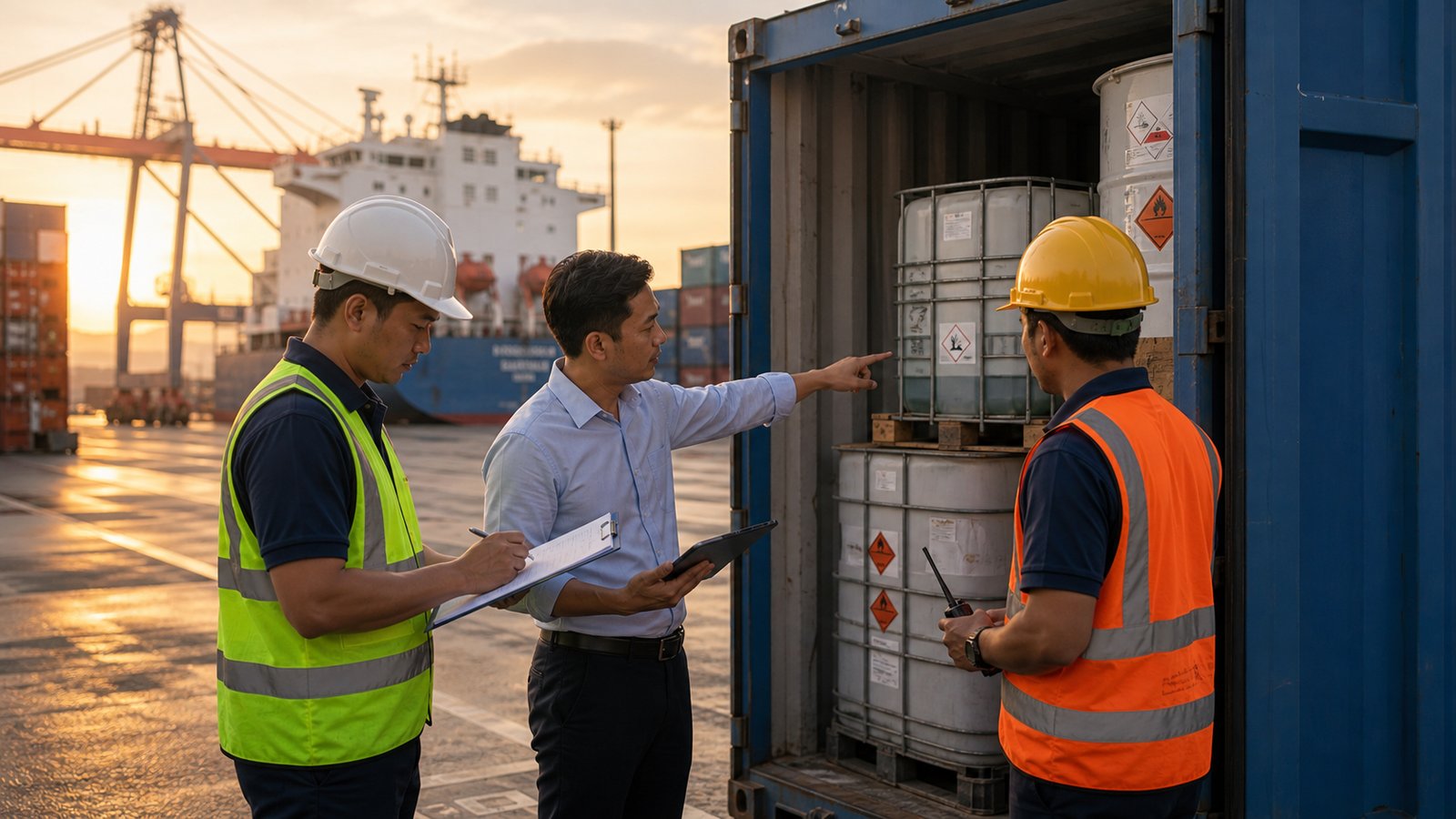
Picture an ordinary Tuesday. A client in Klang sends you a booking for "electronic accessories," 18 pallets, full container load to Rotterdam, and you book it the way you book a dozen others that week. The box loads at Westports, and three days into the voyage there is a fire two bays over that turns out to have started in your container, where the "accessories" were lithium-ion power banks with no UN number, no class, and no dangerous goods paperwork behind them.
From there it moves fast. The shipping line starts talking about general average, the other cargo interests start talking about recourse, and everyone involved goes back to the booking to see whose name is on it. It is yours, and the shipper who gave you the false description has stopped answering the phone.
This is the dangerous goods trap, and on an ordinary day it is the single largest liability a Malaysian forwarder can walk into. The freight on that box might have been RM4,000, but the exposure can run to the vessel's general average contribution and the losses of every other cargo owner aboard. This guide sets out where that liability actually lands, why your client's declaration does not shield you, and how freight forwarder's liability cover responds when it happens.
Key Facts: Misdeclared Dangerous Goods and Forwarder Liability
What counts as misdeclared dangerous goods? It is cargo that is hazardous under the IMDG Code but declared as ordinary cargo, declared under the wrong UN number or class, or packed and documented incorrectly. Lithium batteries declared as electronics, charcoal declared as carbon, and flammable chemicals declared as samples are the classic Malaysian cases.
How common is it? More common than most forwarders assume: a U.S. National Cargo Bureau inspection study found 6.5% of containers carried misdeclared dangerous goods, and TT Club reports a major container ship fire roughly every 60 days, with misdeclared and undeclared DG implicated in a large share of serious cargo incidents.
What is the IMDG Code? It is the International Maritime Dangerous Goods Code, issued by the International Maritime Organization, and it is the mandatory rulebook for carrying dangerous goods by sea. Its current revision, Amendment 42-24, is mandatory from 1 January 2026.
Who is liable when a forwarder books a misdeclared box? The forwarder named on the booking and the bill of lading, because the carrier can pursue that party for breach of the dangerous goods warranty and the other cargo interests can pursue it through general average, often long before the actual shipper is reachable.
What is general average? It is the principle, governed by the York-Antwerp Rules 2016, that when cargo or expense is sacrificed to save a voyage in peril, every cargo interest contributes in proportion to the value saved. A fire that starts in your box can pull every other shipper on the vessel into a claim against you.
Does freight forwarder's liability insurance respond? It can, where the cover includes errors and omissions and cargo legal liability, subject to policy terms and conditions. For the product, see freight forwarder's liability insurance, and for the general average mechanism, see the York-Antwerp Rules 2016.
Why This Is Your Problem, Not Just the Shipper's
The instinct is a fair one. The shipper lied on the declaration, so the shipper should carry the loss, and legally that is often true. The trouble is that it rarely helps you in the first six months after the fire, which is when the claims actually arrive.
The carrier does not chase your shipper, it chases the contracting party on the bill of lading, and on a house bill that party is you. Almost every carrier's terms include a strict dangerous goods warranty under which whoever tenders the cargo guarantees it is correctly declared, packed, marked, and documented, and accepts liability for all loss and damage if it is not. That warranty does not ask whether you knew, so the line simply presents its claim to you.
You are then left to chase your shipper down the chain, and that shipper may be a small trading outfit, may be insolvent, or may simply deny the box was theirs. Because you are the party with the cover and the reachable balance sheet, the claim lands on you first and stays there while you try to recover. The wrong HS code on a customs entry is a parallel exposure that travels the same way, which we cover in wrong HS code and the customs penalty that becomes your bill.
The Three Ways Forwarders Get Caught
Misdeclaration is rarely a dramatic act of smuggling. It is usually one of three ordinary failures, and all three are avoidable once you know to look for them.
The shipper declares it wrong and you pass it on
This is the most common case by far. The shipper books "machinery parts" or "electronic accessories," you build the booking from their instructions, and nobody flags that the line item is really lithium batteries, aerosols, or a flammable adhesive, so you become the conduit for a false declaration without ever touching the cargo.
The defence is a documented screening step that you can point to afterwards. A short dangerous goods questionnaire on every new commodity, a watchlist of high-risk descriptions, and a firm rule that vague descriptions get queried before the booking is confirmed together build the paper trail that shows you acted reasonably.
The classification is wrong, not absent
In this version the shipper does declare dangerous goods, but under the wrong UN number, the wrong packing group, or an entry that the rules have since changed. Amendment 42-24 added new UN numbers for sodium-ion batteries and battery-powered vehicles and removed the old exemption for certain carbon and charcoal shipments, so a declaration that was perfectly correct in 2024 can be wrong in 2026.
This is where keeping current with the IMDG Code earns its keep. A forwarder who books DG should be working from the 2024 Edition incorporating Amendment 42-24 rather than from memory of how the rules used to read.
The packing or documentation fails
Here the goods are declared correctly, but the packing, marking, segregation, or the dangerous goods declaration itself is defective. The National Cargo Bureau inspections found that a majority of DG containers had at least one compliance failure and that many held cargo which was poorly secured, and a correct UN number on a badly packed box still causes the casualty and still exposes whoever tendered it.
Not sure your FFL would respond to a misdeclared DG claim?
Voyage places freight forwarder's liability cover for Malaysian forwarders directly with the underwriters who write these risks, and can check whether your wording includes the errors and omissions and cargo legal liability sections a DG claim needs. Send the details through the quote form for a 48-hour indication, or WhatsApp +60 14 925 5243.
The General Average Multiplier
This is the part that turns a single bad box into a balance-sheet event. When a fire or other peril threatens the whole voyage and the master sacrifices cargo or incurs extraordinary expense to save it, general average is declared, and under the York-Antwerp Rules 2016 every cargo interest on that ship contributes to the loss in proportion to the value saved.
Two things then happen to the forwarder who booked the offending box, and the second is far worse than the first. Your own cargo on the ship, and your client's, is held until a general average bond or deposit is posted, which ties up goods and cash for months. Beyond that, the party whose misdeclared cargo caused the casualty can be denied the protection of general average altogether and pursued directly for the whole loss by the shipowner and the other cargo interests.
So instead of contributing a modest share like everyone else, you become the target for all of it. A mid-size container fire can produce salvage, wreck removal, and cargo losses running into the tens of millions of dollars, and that is the number sitting behind a RM4,000 freight booking once the declaration turns out to be false. For how the mechanism works in detail, see the York-Antwerp Rules 2016.
What Carrier Liability Does Not Save You From
A forwarder under pressure sometimes assumes the convention caps will keep the damage contained, but they will not, and the reason cuts in two directions at once. Against your shipper, the Hague-Visby Rules cap a carrier's liability at roughly $2.70 per kilogramme or $900 per package, which is the most you can recover up the chain. Against you, the dangerous goods warranty is uncapped, because misdeclaration is a breach that strips away the protection of those limits.
That asymmetry is the whole danger: you owe everything and can recover only a fraction. The reference regime is set out in the Hague-Visby Rules, and the wider point that carrier liability rarely matches cargo value runs through the carrier liability gap your clients do not know about.
How Freight Forwarder's Liability Cover Responds
A misdeclared DG claim hits a forwarder in two places at once, so the policy has to cover both. The carrier and the other cargo interests pursue you for the physical loss, which is a cargo legal liability claim, while separately the allegation is that you failed in your duty to screen, classify, or document the cargo, which is an errors and omissions claim.
A freight forwarder's liability policy built for the Malaysian market should carry both sections, along with defence costs, because the legal spend on a contested general average claim can rival the settlement itself. The table below shows where each exposure sits and which section answers it.
| Exposure | Who pursues you | FFL section that responds |
|---|---|---|
| Physical loss to other cargo and the vessel | Carrier and other cargo interests | Cargo legal liability |
| General average contribution and direct recourse | Shipowner via general average adjuster | Cargo legal liability |
| Failure to screen, classify, or document | Client and third parties | Errors and omissions |
| Legal defence of a contested claim | All of the above | Defence costs |
The catch is that not every FFL policy sold in Malaysia includes the errors and omissions section, and some exclude liability arising from dangerous goods entirely unless the cargo has been declared and the cover endorsed. Reading the wording before the claim rather than after it is, in practice, the whole job. For the product and how it is placed, see freight forwarder's liability insurance and the wider marine liability cover, with the sector view on freight forwarders and logistics.
A Practical Screening Routine
You cannot inspect every box, but you can build a routine that catches the obvious risks and proves you tried, and four steps cover most of the exposure. The first is to screen the commodity description on every booking against a watchlist, so that batteries, power banks, aerosols, paints, adhesives, charcoal, lighters, perfumes, and anything labelled "sample" or "parts" that might be hiding a chemical all get queried before the booking is confirmed.
The second is to require a signed shipper's dangerous goods declaration wherever DG is admitted, and to keep the indemnity language in your trading conditions current, because your standard trading conditions are the contractual backstop when a shipper has misled you and they need to say what you need them to say. The third is to keep the IMDG reference current by working from the 2024 Edition incorporating Amendment 42-24 and briefing documentation staff on the new battery and carbon entries.
The fourth is to match the cover to the exposure. A forwarder who handles any DG, or any cargo that could quietly turn out to be DG, needs an FFL limit and a wording that anticipates a general average claim rather than a policy sized only for ordinary cargo damage.
Frequently Asked Questions
Am I liable if my client misdeclared the cargo, not me?
Often yes, because the carrier pursues the party named on the bill of lading, which on a house bill is you, under a strict dangerous goods warranty that does not require you to have known. You then have a recovery claim against your shipper, but you carry the loss and the cash-flow hit first. Documented screening and current trading conditions strengthen your position when you do.
What is the IMDG Code Amendment 42-24 and when does it apply?
It is the latest revision of the International Maritime Dangerous Goods Code, adopted by IMO Resolution MSC.556(108), and it is mandatory from 1 January 2026. It adds UN numbers for sodium-ion batteries and battery-powered vehicles and removes some carbon and charcoal exemptions, which means a declaration that was correct under the old rules can be wrong now.
Why would general average pull me in for the whole loss?
Because the party whose misdeclared cargo caused the casualty can lose the protection of general average and be pursued directly by the shipowner and every other cargo interest. Instead of paying a small proportional share, you become the target for the full salvage, wreck-removal, and cargo loss, which is how one bad box can become a multi-million-dollar exposure.
Does my freight forwarder's liability policy cover dangerous goods claims?
It can, if the wording includes cargo legal liability and errors and omissions and does not exclude dangerous goods, subject to policy terms and conditions. Some Malaysian FFL policies exclude DG unless it is specifically declared and endorsed, so the sensible move is to check the wording before you book DG rather than after a claim.
How much cover do I need for this exposure?
Enough to meet a general average and recourse claim from a serious container fire, which sits far above ordinary cargo-damage levels. The right limit depends on the trades you handle and whether you touch DG at all, so it is sized against your actual exposure rather than a default figure, and a specialist placement can model this with you.
Voyage Conclusion
A misdeclared dangerous goods box is the rare case where the freight earned and the liability faced are not in the same universe, and where the convention caps end up protecting everyone except the forwarder who tendered the cargo. Screening, current IMDG knowledge, and well-drafted trading conditions all reduce the chance of it happening, but only the right cover meets the bill when it happens anyway.
Voyage places freight forwarder's liability cover for Malaysian forwarders directly with the underwriters who write these risks, and can check that your wording carries the errors and omissions and cargo legal liability sections a DG claim demands. See freight forwarder's liability insurance, the freight forwarders and logistics view, and why your forwarder is not your client's insurer. For a quote, use the contact form or WhatsApp +60 14 925 5243 for a 48-hour indication.
Disclaimer: This article provides general guidance on misdeclared dangerous goods and freight forwarder liability as of June 2026. Coverage terms, conditions, and availability vary by insurer, policy, and jurisdiction. Regulatory requirements differ between countries and may change.
Always review your specific policy wording and consult a qualified insurance or legal professional before making coverage decisions.
Why Voyage
Marine Insurance Specialists
International Underwriter Access
Both Sides of the Supply Chain
Malaysia and Singapore Expertise
Other industries
Explore other industries we cover


Get Best Rates / Quotation

Voyage is a specialist marine insurance intermediary arranging marine cargo and marine liability coverage for businesses in Malaysia, Singapore, and internationally. All insurance is placed through licensed broking partners.
Riskflow Sdn Bhd (202101001225):
Suite 3.19 (North Block), The Ampwalk, 218 Jalan Ampang, 50450 Kuala Lumpur, Wilayah Persekutuan Kuala Lumpur
t: +60149255243 (Kevin H.)
email: kevin@voyagecover.com