Durian Cargo Insurance: Malaysia to China by Air and Sea
How to insure fresh and frozen durian shipped from Malaysia to China against spoilage, delay, ripening and customs rejection on the 36-hour race.
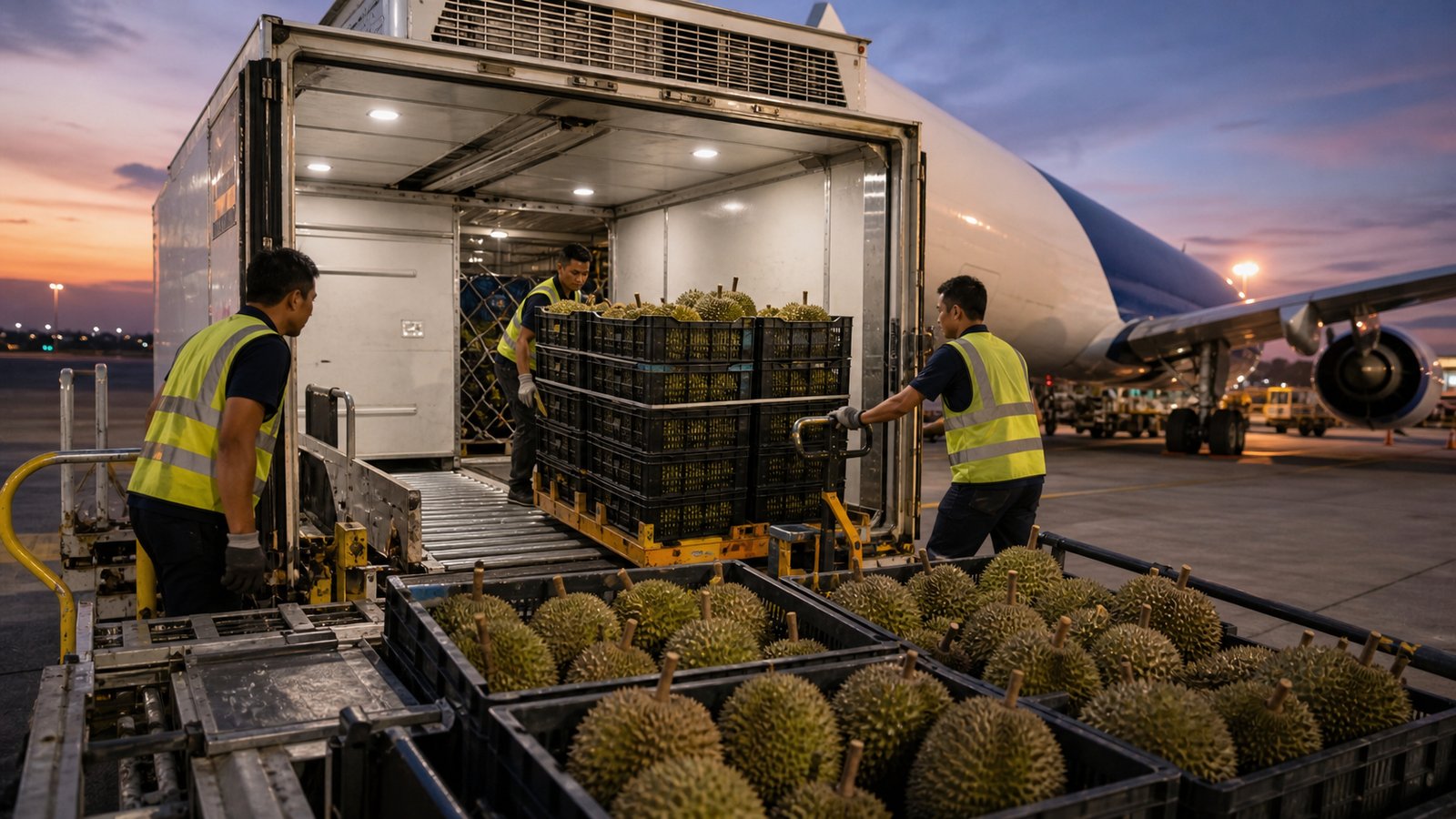
A pallet of fresh Musang King leaves a Pahang orchard at first light, clears MAQIS inspection by noon, and is meant to be on a freighter to Zhengzhou that evening. The clock that matters is not the shipping schedule; it is the fruit itself. Fresh whole durian keeps for only a handful of days once cut from the tree, and a six-hour hold on the airport ramp can be the difference between a premium consignment and a write-off. When a shipment of around 15 tonnes of fresh Malaysian durian first landed at Zhengzhou Xinzheng International Airport in late August 2024, the industry headline was market access. The quieter story was logistics: durian transported by air can reach China within roughly 48 hours of harvest, and every hour of that window carries cargo risk.
Why durian is a hard cargo to insure
Durian is a living, respiring fruit that continues to ripen after harvest, generates heat, and degrades fast once the cold chain wobbles. That makes it one of the more demanding perishable cargoes a Malaysian exporter can put on a plane or a reefer. The corridor to China rewards speed and punishes any pause, and the insurance question is rarely "is it covered" in the abstract; it is "what exactly went wrong, when, and can you prove it." This guide walks the Malaysia to China durian corridor end to end: the trade context, the specific risks, how cover is built, the documentation and Incoterms patterns that decide claims, and where claims actually fail.
Key Facts: Durian Cargo Insurance Malaysia to China
Is durian cargo insurable for the Malaysia to China route? Yes, both fresh and frozen durian can be insured under marine and air cargo policies, though perishable produce needs specific extensions for chilling, ripening and delay rather than a plain all-risks wording. The cover has to match the cold-chain protocol the fruit travels under.
What is the main risk on this corridor? Temperature excursion and delay leading to spoilage are the dominant exposures, because fresh durian has a short post-harvest life and any hold at origin, in transit or at the China border can ruin the consignment. Physical damage and theft are secondary by comparison.
Does cargo insurance pay if China customs rejects the shipment? Not usually on its own. Rejection for a documentary or phytosanitary failure under the GACC protocol is a regulatory event, not physical loss or damage, so it falls outside a standard cargo policy unless a specific rejection or condemnation extension has been arranged.
What protocol governs durian into China? Frozen whole durian has been permitted under a Malaysia to China protocol signed on 20 August 2018, with commercial shipments from May 2019; fresh whole durian gained market access under the Protocol of Phytosanitary Requirements signed on 19 June 2024 with China's General Administration of Customs, GACC, with exports commencing in the third quarter of 2024. Source: Malaysian Ministry of Agriculture and Food Security, 2024.
How is frozen Musang King processed for export? Approved frozen whole durian is flash-frozen, with the nitrogen freezing process holding the fruit between minus 80 and minus 110 degrees Celsius for not less than one hour before frozen storage and transport. Source: FAMA Standard Operating Procedure for exporting frozen whole durian to China.
How big is the Musang King exposure? Musang King dominates Malaysian durian planting, with close to half of the country's durian plantation area given over to the variety, which concentrates value and therefore insured exposure in a single cultivar. Source: Produce Report, 2024.
The corridor: lanes, modes and the clock
Two distinct products travel this route under two different protocols, and they carry different risk profiles. Fresh whole durian moves almost entirely by air for the long-haul leg, because the post-harvest window is too short for ocean transit on premium grades, with the first fresh air consignments routing into airports such as Zhengzhou from mid-2024. Frozen whole durian, flash-frozen by the nitrogen process described above, travels as deep-frozen reefer cargo by sea or air and tolerates a longer journey, which changes both the dominant peril and the claims evidence you need.
The fresh-fruit leg is a race. From orchard to MAQIS clearance to airport build-up to flight to GACC inspection in China, the consignment passes through several custody handoffs in roughly a day and a half, and any one of them can introduce a delay or a temperature break. The frozen leg is more forgiving on time but unforgiving on temperature integrity: a single thaw-and-refreeze cycle can compromise texture and create a quality dispute even where the carton arrives intact. Understanding which product you ship, and on which mode, is the first step in matching cover to cargo. For a wider view of how perishable and halal-certified produce is insured out of Malaysia, our food, beverage and halal exports cargo insurance overview sets the context.
Risk profile on the Malaysia to China durian corridor
The risks cluster into four groups, and they do not weigh equally. First, temperature and ripening: fresh durian respires and ripens in transit, so an under-cooled reefer or a warm ramp hold accelerates over-ripening, while frozen durian is vulnerable to thaw if a unit fails. Second, delay: a missed connection, a ramp backlog, or a slow border inspection can push fresh fruit past its commercial life even though nothing was physically damaged. Plain cargo wordings exclude loss caused by delay, which is exactly why durian needs careful structuring.
Third, customs and protocol risk at the China end: the GACC fresh-durian protocol sets phytosanitary and registration conditions, and a consignment can be held, downgraded or rejected on inspection for reasons that have nothing to do with insurable physical damage. Fourth, handling and contamination: durian is sensitive to bruising, ethylene exposure from co-loaded produce, and odour cross-contamination, any of which can trigger a buyer dispute on arrival. The exclusions that bite hardest here are the ones common to all-risks cargo cover under the Institute Cargo Clauses (A), 2009 edition: inherent vice, ordinary loss in condition, insufficiency of packing, and delay. For the underlying logic of what those clause sets cover and exclude, see our guide to the Institute Cargo Clauses.
Building the insurance programme for durian
For a regular durian exporter, the natural base is an all-risks marine and air cargo wording arranged on an open cover, so that every consignment in the season is automatically declared and insured without a fresh negotiation per shipment. An open cover marine cargo policy suits shippers running frequent, repeating lanes through a harvest season, while a grower or trader sending occasional trial lots may prefer single shipment marine cargo insurance per consignment. The trade-offs between the two structures are set out in our comparison of open cover versus single shipment cover.
On top of the base wording, durian needs the extensions that address its actual failure modes. A refrigerated cargo or temperature-variation extension responds to chilling damage from machinery breakdown or power failure in the reefer unit, which a bare all-risks wording may not cover where the loss looks like a gradual condition change rather than a sudden event. A deterioration or spoilage extension can bring some delay-linked loss back into scope, though insurers will scrutinise the cause and the cold-chain record closely. Where the commercial worry is the China border rather than the journey, a rejection or condemnation extension is a separate conversation, and it is not automatic. None of these extensions substitute for getting the protocol compliance right; cargo insurance pays for physical loss and damage, not for a failure to meet GACC entry conditions.
Documentation and Incoterms patterns on this route
Incoterms 2020 decide who carries the risk at each point and therefore who needs to insure. Many durian deals run on CIF or CIP terms where the Malaysian seller arranges carriage and insurance to China; under Incoterms 2020, CIP requires Institute Cargo Clauses (A) as the minimum cover, while CIF requires only the more restrictive Institute Cargo Clauses (C) minimum. For a perishable, high-value cargo like durian, the (C) floor is rarely adequate, so even on a CIF sale a prudent exporter buys up to all-risks rather than shipping on the bare minimum. Our Incoterms 2020 guide explains how the eleven rules allocate cost, risk and the insurance duty.
The evidence file is what turns a loss into a paid claim. For durian, the cold-chain record is central: continuous temperature logger data from origin to destination, the reefer set-point and download, the airway bill or bill of lading with timestamps, the phytosanitary and GACC registration documents, the commercial invoice and packing list, and a survey report or photographs of the damaged consignment taken before disposal. Where air freight is involved, the carrier's liability is capped under the Montreal Convention 1999 at 26 Special Drawing Rights per kilogram, far below the commercial value of premium durian, which is precisely why first-party cargo cover matters rather than relying on a recovery from the airline. For the phytosanitary paperwork that travels with the fruit, see our guide to the phytosanitary certificate for Malaysian agricultural exports, and for the broader China lane our overview of China cargo insurance considerations.
Common claims on the durian corridor
The most frequent claim is spoilage of fresh fruit traced to a delay or a temperature break, and these split cleanly on the evidence. Where the logger shows a discrete reefer failure or a power outage, the loss looks like insured physical damage and the claim is straightforward against a temperature-variation extension. Where the logger shows the cargo simply ran out of time in an unbroken but slow cold chain, the insurer is likely to point to the delay exclusion and the inherent perishability of the fruit. The second common pattern is a buyer rejecting frozen durian on quality grounds after a suspected thaw-and-refreeze, where the dispute turns on whether there was a covered excursion at all. The third is a border hold or rejection at GACC inspection, which a standard cargo policy will decline as a regulatory rather than physical loss. In every case, the difference between a paid and a declined claim is the quality of the cold-chain and documentary record, not the headline "all-risks" label on the policy.
Frequently asked questions
Does standard all-risks cargo insurance cover durian spoilage?
Not reliably. All-risks cover under Institute Cargo Clauses (A), 2009 edition, excludes loss caused by delay, inherent vice and ordinary deterioration, which describe most durian spoilage. A perishable shipment needs specific refrigeration, temperature-variation and deterioration extensions arranged on top of the base wording to respond to cold-chain and ripening losses.
Is fresh durian or frozen durian harder to insure?
Fresh durian carries more time and delay exposure because of its very short post-harvest life and its reliance on air freight, so delay-linked spoilage is the central concern. Frozen durian is more time-tolerant but exposed to thaw and refreeze quality disputes, so the cover and the evidence differ between the two products.
Will cargo insurance pay if Chinese customs rejects my durian?
Generally no, unless a specific rejection or condemnation extension has been arranged. Rejection under the GACC protocol for a phytosanitary or documentary reason is a regulatory event, not insured physical loss or damage, so a standard cargo policy will decline it. Getting protocol compliance right is the primary safeguard; insurance does not substitute for it.
What Incoterm should a durian exporter use into China?
Many shippers use CIF or CIP so the seller controls carriage and insurance. Under Incoterms 2020, CIP requires Institute Cargo Clauses (A) cover as a minimum and CIF requires only Institute Cargo Clauses (C); for a perishable cargo, buying up to all-risks rather than the (C) floor is the safer choice regardless of the term.
How much does the airline pay if durian is lost or spoiled in air transit?
Carrier liability for air cargo is limited under the Montreal Convention 1999 to 26 Special Drawing Rights per kilogram, which is well below the commercial value of premium durian. First-party cargo insurance covers the full insured value, while a claim against the airline is capped and often slow, so the two are not equivalent.
What evidence do I need to support a durian spoilage claim?
Continuous temperature logger data across the whole journey, the reefer set-point and download, timestamped transport documents, the phytosanitary and GACC paperwork, the invoice and packing list, and a survey report or dated photographs taken before disposal. The cold-chain record is the single most important element and should never be discarded with the damaged fruit.
Should a seasonal durian shipper use open cover or single-shipment cover?
A grower or trader sending frequent consignments through a harvest season usually benefits from an open cover, which declares and insures each shipment automatically. A shipper sending only occasional trial lots may find single shipment cover per consignment simpler. The right structure depends on shipment frequency and value through the season.
Insuring Malaysia to China durian cargo with Voyage
Durian is a cargo where the wording has to follow the cold chain, and Voyage arranges marine and air cargo cover, on open cover or single shipment terms, structured around the temperature, delay and protocol realities of the China lane rather than a generic all-risks template.
Get a tailored quote. WhatsApp Kevin at +60 14 925 5243 or request a callback. Quotes turn around in 24-48 hours where the underlying cover is in place.
Disclaimer: This article provides general guidance on durian cargo insurance for the Malaysia to China corridor as of June 2026. Coverage terms, conditions, and availability vary by insurer, policy, and jurisdiction. Always review your specific policy wording and consult a qualified insurance professional before making coverage decisions.
Why Voyage
Marine Insurance Specialists
International Underwriter Access
Both Sides of the Supply Chain
Malaysia and Singapore Expertise
Other industries
Explore other industries we cover


Get Best Rates / Quotation

Voyage is a specialist marine insurance intermediary arranging marine cargo and marine liability coverage for businesses in Malaysia, Singapore, and internationally. All insurance is placed through licensed broking partners.
Riskflow Sdn Bhd (202101001225):
Suite 3.19 (North Block), The Ampwalk, 218 Jalan Ampang, 50450 Kuala Lumpur, Wilayah Persekutuan Kuala Lumpur
t: +60149255243 (Kevin H.)
email: kevin@voyagecover.com