Insuring Palm Oil Exports from Malaysia: Contamination, Flexitank Failure, and Middle East Routing in 2026
How Malaysian palm oil exporters insure CPO and palm olein in 2026: contamination, flexitank failures, EUDR pressure, and Hormuz routing.
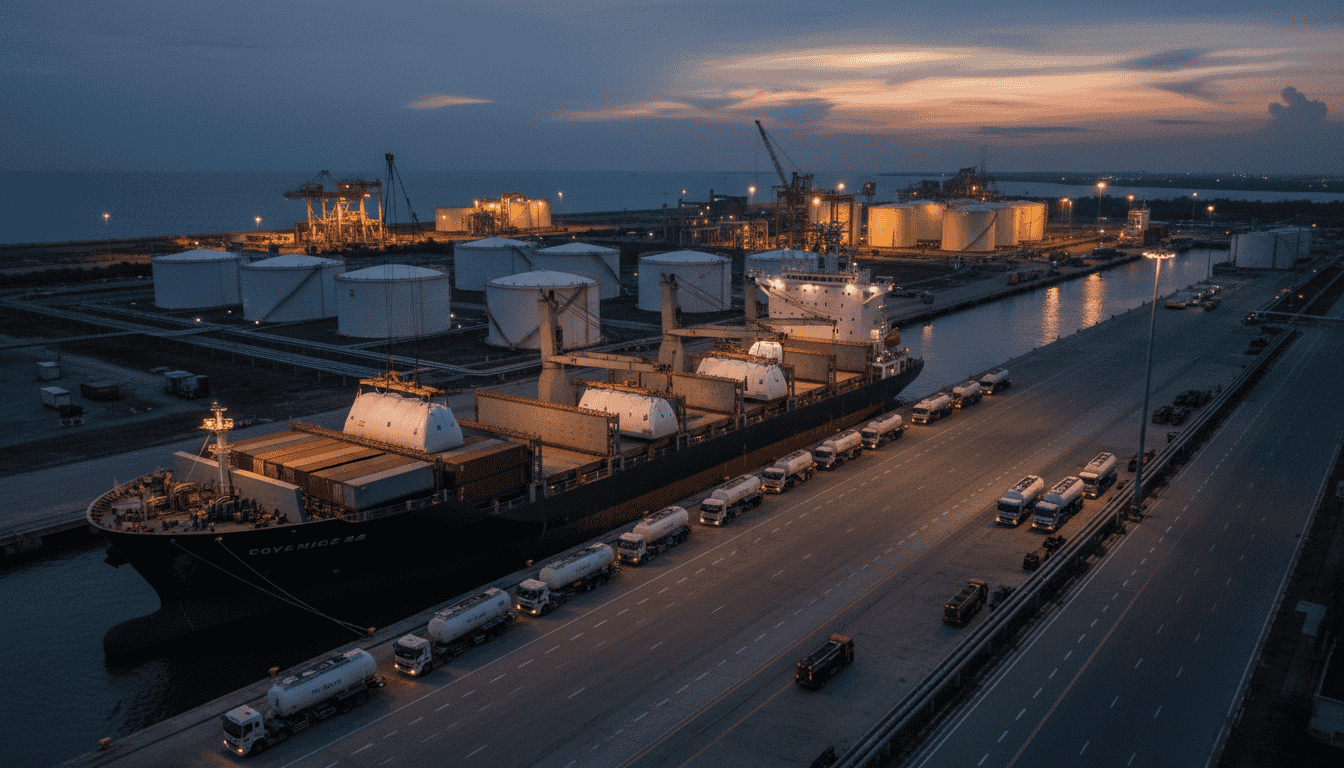
Insuring Palm Oil Exports from Malaysia: Contamination, Flexitank Failure, and Middle East Routing in 2026
A documented Maritime Mutual case report describes a discharge operation where crude palm oil was contaminated with palm kernel oil through the discharge-line valving. The cargo owner's claim was settled for more than USD 600,000. The cargo had not sunk. The vessel had not collided with anything. The hatches had not been broken into. A valve leaked between paired tanks, and the loss was made.
That is how palm oil losses actually happen. Malaysian exporters who think of cargo insurance in terms of perils that look like accidents (vessel sinking, fire, piracy) tend to underinsure for the things that actually move money: cross-product contamination at discharge, flexitank rupture in the container yard, and apparent shortage on solidified cargo. This article walks through the four loss patterns the placement market prices, the EUDR pressure that arrives on 30 December 2026, and the routing implications of the Joint War Committee circular dated 3 March 2026 for cargoes moving through the Middle East corridor.
Where Malaysian palm oil moves in 2026, and what changed
Malaysian palm oil exports earned RM99.29 billion (FOB) in 2024, or RM109.39 billion including re-exports, on volume of 24.57 million tonnes (MPOB 2024). Crude palm oil production in 2025 is projected to exceed 19.5 million tonnes. The trade is not in decline. It is reorganising.
Three reorganisations matter for insurance. The first is regulatory: the EU Deforestation Regulation entered its full enforcement window for large and medium operators on 30 December 2026, with micro and small enterprises following on 30 June 2027 (Regulation (EU) 2025/2650, December 2025 amendment). The second is corridor: Sub-Saharan Africa took roughly 577,000 tonnes in October 2025 alone, and Hormuz routing for Middle East and North Africa shipments now carries war-cover implications it did not in 2023. The third is structural: traders who had open covers placed in 2022 are renewing now into a market where declared turnovers, conveyance limits, and Listed Areas have all moved.
The exporter who reads this article most usefully is the one whose 2026 shipments will touch the EU border, the Middle East corridor, or both, and whose policy was last reviewed in 2023.
| Where Malaysian palm oil moves | Insurance implication in 2026 |
|---|---|
| EU (Netherlands, Italy, Spain) | EUDR Article 9 documentation is the gating issue; cargo policy responds to physical loss only, not regulatory rejection |
| India and Pakistan (refining and consumption) | High contamination-claim incidence; specification disputes on FFA, moisture, peroxide; surveying at discharge is decisive |
| China (food and oleochemical use) | Cold-weather solidification on northern routes; tank-heating coil specification matters |
| Sub-Saharan Africa (record growth in 2024 and 2025) | Long voyage, transhipment risk, payment risk; war cover required where routing touches Listed Areas |
| Middle East and North Africa (Egypt, Saudi Arabia, Türkiye) | JWLA-033 dated 3 March 2026 expanded Listed Areas; war cover and AP scrutiny apply to most routings |
For ongoing programmes that span these destinations across multiple shipments per year, Marine Cargo Open Cover is the structure that holds; for one-off project shipments, Single Shipment Marine Cargo Insurance is the alternative. Read more on Palm Oil Cargo Insurance Malaysia.
Talk to Voyage about Cargo Insurance with Claims Support
Voyage arranges Marine Cargo Insurance, Marine Cargo Open Cover, and Single Shipment Marine Cargo Insurance for Malaysian and Singaporean traders, exporters, and importers, with active claims support included. WhatsApp +60 14 925 5243 or use the contact form.
Loss pattern 1: contamination
Cross-product contamination is the single most expensive recurring loss in palm oil. The pattern is well documented. A vessel carrying CPO in one tank and palm kernel oil in an adjacent paired tank discharges through a shared line. A valve between the two tanks leaks. The buyer receives CPO that is technically out of specification and either rejects it outright or accepts at a heavily discounted price. The Maritime Mutual case report cited at the top of this article settled for more than USD 600,000.
Other contamination patterns include residue from the previous cargo (insufficiently cleaned tanks before loading), water entry through ullage caps in heavy weather, and contamination at the shore tank prior to loading. Each carries a different insurance treatment and a different burden of proof at claim.
Institute Cargo Clauses (A) 2009 respond to fortuitous physical loss or damage to the cargo, subject to the policy terms and conditions. Clause 4 lists the standard exclusions. Clause 4.4 excludes inherent vice (palm oil's own properties causing its deterioration is excluded), Clause 4.5 excludes delay (loss caused by delay alone is excluded even if the proximate peril is otherwise covered), and Clause 4.6 excludes insolvency or financial default of carriers. Cross-cargo contamination from external cause (a leaking valve in the vessel's discharge line) is generally a covered cause; inherent vice contamination from your own product's properties is not. The line is sometimes contested at claim, which is why surveying at load and discharge is the decisive evidence.
Loss pattern 2: flexitank failure
Flexitanks (single-use polyethylene bladders fitted into 20-foot dry containers) are the dominant packaging for palm olein and refined palm products on container routes. They are cheaper than ISO tanks and friendlier to drop-trailer operations at port. They also fail.
The principal failure modes are seam rupture under load (poor seam construction, over-filling, vibration in transit), valve failure (manufacturing defect, mishandling at fill), and weight-distribution failure (the container's bulkhead is overstressed by the bladder's hydrostatic pressure, and the doors burst inward or outward). A single ruptured flexitank can lose 18 to 24 tonnes of product, plus the cleanup cost at the terminal, plus claims from any adjacent containers contaminated by the spill.
For coverage to respond cleanly, the flexitank specification, the loading procedure, and the container condition all matter. ICC (A) 2009 covers physical loss or damage from external cause subject to policy terms and conditions. Loss caused by insufficiency of packing (Clause 4.3) is excluded if the packing was insufficient at the time of attachment of the cover. The claim battleground is usually whether the flexitank was specification-correct and properly fitted, or whether the packing was inherently inadequate from the start.
Loss pattern 3: solidification and apparent loss
Crude palm oil's slip melting point is approximately 35°C; the full solidification range is 31°C to 41°C. The Codex Alimentarius recommended discharge range is 50°C to 55°C, which the vessel must achieve through the tank heating coils before the discharge starts. If the heating coils are undersized, malfunctioning, or the voyage is unusually long, the cargo arrives partially solidified.
Two consequences follow. The first is operational: the discharge takes longer, demurrage accumulates, and tank residue (oil that physically cannot be pumped out at the achieved temperature) is left in the tank. The second is financial: the apparent quantity discharged falls below the bill of lading quantity. If the shortage is within the customary trade allowance (typically 0.5 percent), no claim is made. If the shortage exceeds the allowance because of measurement error caused by partial solidification, the cargo owner has a shortage claim on their hands.
Insurance treatment depends on whether the loss is real (oil physically lost overboard or to leakage) or apparent (oil still in the tank but unmeasurable at the achieved temperature). Real loss is usually covered subject to policy terms and conditions. Apparent loss from inadequate heating is contested, sometimes successfully against the insurer if the cargo owner can show the vessel's heating system was not maintained to specification, sometimes successfully against the carrier under the bill of lading.
Loss pattern 4: rejection at destination
The cargo arrives in specification. The discharge proceeds. The buyer rejects the cargo on a technical specification (FFA above contract limit, moisture above contract limit, colour outside specification, peroxide value above limit). Or the buyer's regulator rejects the consignment for a documentary reason (Halal certificate missing, palm oil sustainability documentation incomplete, EUDR DDS rejected at the EU border).
This is the loss pattern that ICC (A) 2009 typically does not respond to without a specific extension. ICC (A) is a physical loss policy. Rejection on quality or documentary grounds where the cargo is undamaged is a commercial loss, not a physical loss, and falls outside the standard policy unless a rejection extension has been placed (a separate market in the specialist underwriting capacity, available for some commodity flows but not all).
The EUDR enforcement timeline (30 December 2026 for large and medium operators) makes this loss pattern materially more probable for palm oil exporters in 2027 onwards. We cover the EUDR documentation chain in detail in the EUDR Article 9 enforcement piece; the relevant point here is that your cargo policy is unlikely to be the right instrument for that risk on its own.
EUDR exposure for cargo in transit
The EU Deforestation Regulation (Regulation (EU) 2023/1115, December 2025 amendment) requires operators placing oil palm products on the EU market to file a Due Diligence Statement (DDS) supported by geolocation polygons of every plot of more than 4 hectares used to produce the commodity. The DDS reference number, not the DDS itself, is what downstream traders and importers retain after the December 2025 simplification.
The in-transit gap looks like this. Your shipment leaves Port Klang or Pasir Gudang on a CFR or CIF basis. Mid-voyage, the EU buyer's compliance team flags an issue with the DDS reference number (a parcel polygon shows a forest-loss flag in EU monitoring data, a supplier link is missing in the chain, a country-of-production document is unverifiable). The cargo arrives at Rotterdam and cannot enter the EU market in the form intended. The cargo owner is now negotiating one of three outcomes: (a) re-routing to a non-EU buyer, often at a steep discount, (b) holding in bonded storage while documentation is rebuilt, with demurrage and storage cost accumulating, (c) abandoning the consignment.
The cargo policy responds to the cargo. It does not respond to the EUDR rejection itself. The exposure is best managed by getting EUDR readiness right at origin (our EUDR compliance guide covers the broader framework, and the Article 9 enforcement piece goes deeper on what EU buyers now demand), structuring the sale contract so the EU buyer carries the rejection risk where possible, and considering rejection extensions or specific contingent covers where the placement market will write them, subject to policy terms and conditions.
Hormuz and Red Sea routing implications
The Joint War Committee's circular JWLA-033 dated 3 March 2026 expanded the Listed Areas substantially. The Persian/Arabian Gulf is now in its entirety a Listed Area, including the Strait of Hormuz. The Red Sea south of 18°N is listed, including Yemeni waters. Bahrain, Djibouti, Kuwait, Oman, and Qatar were added as listed countries. Indian Ocean zones near Somalia and Pakistan were expanded.
For palm oil cargoes routing to or through Egypt, Saudi Arabia, the UAE, Türkiye, or Sub-Saharan Africa via the Red Sea, the practical implications are two. First, war cover is now formally required at additional premium on the affected legs, applied as an AP either by route or per voyage. Institute War Clauses (Cargo) CL385 dated 01.01.2009 are the standard form. Cargo war risk runs to a 7-day cancellation notice (different from the 48-hour automatic termination on hull war risk), so the cover is reasonably stable but not unconditionally guaranteed for a multi-month voyage.
Second, route alternatives now have insurance economics attached to them. A vessel routing via the Cape of Good Hope rather than the Suez and Red Sea avoids the Listed Area but adds 10 to 14 days, fuel cost, and a different war exposure. A trader's choice of vessel and route is a war-cover variable, not just a freight variable. Our deeper treatment of the surcharge mechanics is in why your war risk surcharge just changed, and the corridor-specific position is in Strait of Hormuz cargo insurance 2026.
How a Malaysian palm oil cargo policy is actually structured
Most placements for an established exporter look like the structure below. Read the table together with the surrounding context: this is a coverage architecture, not a quote.
| Layer | Form | Comment |
|---|---|---|
| Base cargo | Institute Cargo Clauses (A) 2009 | All risks with specific exclusions; subject to policy terms and conditions |
| War (sea) | Institute War Clauses (Cargo) CL385 dated 01.01.2009 | Reinstates the war exclusion at Clause 6 of ICC (A); 7 days cancellation notice |
| Strikes | Institute Strikes Clauses (Cargo) CL386 dated 01.01.2009 | Reinstates the strikes exclusion at Clause 7 of ICC (A) |
| Sum insured | CIF + 10% (UCP 600 Article 28(f)(ii) default) | Higher uplift used in some contracts; verify against buyer or LC |
| Currency | USD typically; LC currency where letter of credit involved | Mismatch is a common LC discrepancy |
| Mechanism | Open cover for regular shippers; single shipment for ad hoc | Open cover with monthly declarations is the dominant form for traders |
The decisions inside this structure are where placement quality shows up: declared turnover that reflects 2026 export volumes (not the 2022 number from when the cover was set up), per-conveyance limits that reflect today's CIF values per container or per bulk lift, and a clause endorsement matrix that aligns with the actual mix of buyers in the book. We cover the underwriting view of these decisions in what underwriters actually look at when pricing your shipment.
Three under-insurance traps Malaysian palm oil exporters fall into
The first trap is the FOB seller relying on the buyer's cover. The Incoterms 2020 FOB rule transfers risk at the on-board moment but obliges neither party to insure. If the buyer says they have arranged cover and the seller does not verify, the pre-loading risk window (warehouse, road haul, terminal, lift to vessel) is uninsured, and the seller is exposed for a window the seller probably does not realise they own. Our piece on this is selling FOB but the buyer demands ICC (A).
The second trap is declared turnover that lags actual volume. An open cover with declared turnover of RM200 million in 2024 might be running RM280 million through 2025 and 2026 without amendment. The exposure is two-fold: the rate is built on the lower number, so the underwriter is under-priced; and at claim, the bordereaux mismatch can become a coverage argument. The fix is mid-term turnover review, not waiting until the renewal.
The third trap is sum-insured currency mismatch with the LC. A USD 100,000 CIF shipment under a USD letter of credit needs USD 110,000 cover (UCP 600 Article 28(f)(ii)). If the cargo certificate is issued in MYR or SGD on the basis of the open cover's home currency, the bank rejects on currency mismatch. The fix is at the declaration template level, addressed in detail in when your bank rejects your cargo insurance certificate.
Frequently asked questions
Does ICC (A) 2009 cover contamination?
It depends on the cause. ICC (A) 2009 covers fortuitous physical loss or damage subject to the Clause 4 exclusions. Cross-cargo contamination from an external cause (a leaking valve in the vessel's discharge line, residue from a previous cargo) is generally a covered cause. Inherent-vice contamination from the product's own properties (Clause 4.4) is excluded, subject to policy terms and conditions.
Who is responsible if my flexitank ruptures in transit?
Liability sits with whoever's act or omission caused the rupture. If the flexitank was specification-correct and properly fitted, and the rupture is caused by an external event in transit (heavy weather, mishandling), ICC (A) 2009 typically responds, subject to policy terms and conditions. If the packing was inadequate at the time of cover attachment (the wrong specification flexitank for the route, an under-fill or over-fill error), Clause 4.3 of ICC (A) 2009 may exclude the loss.
Does cargo insurance respond if a buyer rejects on EUDR grounds?
Generally no, not without a specific extension. ICC (A) 2009 is a physical loss policy. EUDR rejection at the EU border is a commercial or regulatory loss where the cargo is typically undamaged. The exposure is best managed by EUDR readiness at origin, by sale-contract structuring, and where placement is available, by a rejection extension or specific contingent cover, subject to policy terms and conditions.
Do I need war cover for shipments to Sub-Saharan Africa?
Yes, in practical terms. Routing to West Africa avoids most Listed Areas if the vessel takes the Cape route. Routing to East Africa typically passes through the Red Sea south of 18°N (a Listed Area under JWLA-033 dated 3 March 2026) or via the Gulf of Aden, where additional premium and route conditions apply. A formal war risk extension via Institute War Clauses (Cargo) CL385 is the standard treatment.
Does CIF cover me as the seller all the way to discharge?
Under Incoterms 2020, CIF transfers risk to the buyer at the on-board moment at the port of shipment. The seller's obligation is to procure insurance on at least Institute Cargo Clauses (C) 2009 minimum (named perils only) for the buyer's benefit, to the named port of destination. Many sale contracts contractually require ICC (A) instead of the (C) minimum; check the sale contract wording.
What sum insured does my LC bank expect?
UCP 600 Article 28(f)(ii) requires a minimum of 110% of the CIF or CIP value if the credit does not state a different figure. Some sale contracts contractually require a higher uplift (115% or 120%). Always reconcile the certificate's sum insured to the LC's wording, not to the invoice value alone.
Voyage Conclusion
Palm oil losses in 2026 do not look like the perils on a wall poster. They look like a leaking valve at discharge, a flexitank rupture in a yard, a partial solidification on a long voyage, and a DDS reference flagged at the EU border. Each is insurable in some respect, and each requires a policy and placement built for the way Malaysian palm oil actually ships, not a generic cargo certificate.
Talk to Voyage about Marine Cargo Open Cover for Malaysian palm oil exporters shipping CPO, palm olein, and refined products from Port Klang, Pasir Gudang, and Lahad Datu to EU, MENA, India, China, and West African destinations. For one-off project transits, Single Shipment Marine Cargo Insurance is the alternative. For the corridor-specific industry view, see Palm Oil Cargo Insurance Malaysia. WhatsApp +60 14 925 5243 or use the contact form.
Talk to Voyage about Your Cargo Programme
WhatsApp +60 14 925 5243 or use the contact form.
Related guides: EUDR Article 9 enforcement for palm oil and rubber exporters, insuring rubber and latex exports from Malaysia, Palm Oil Flexitank Cargo Claim Defence Checklist, Cargo Claims Denied for Packing, Hormuz / Red Sea Cargo War Risk Briefing.
Disclaimer: This article provides general guidance on insuring palm oil exports from Malaysia as of April 2026. Coverage terms, conditions, and availability vary by insurer, policy, and jurisdiction. Regulatory requirements differ between countries and may change. Always review your specific policy wording and consult a qualified insurance or legal professional before making coverage decisions.
Why Voyage
Marine Insurance Specialists
International Underwriter Access
Both Sides of the Supply Chain
Malaysia and Singapore Expertise
Other industries
Explore other industries we cover


Get Best Rates / Quotation

Voyage is a specialist marine insurance intermediary arranging marine cargo and marine liability coverage for businesses in Malaysia, Singapore, and internationally. All insurance is placed through licensed broking partners.
Riskflow Sdn Bhd (202101001225):
Suite 3.19 (North Block), The Ampwalk, 218 Jalan Ampang, 50450 Kuala Lumpur, Wilayah Persekutuan Kuala Lumpur
t: +60149255243 (Kevin H.)
email: kevin@voyagecover.com